Canalblog Tous les blogs Top blogs Emploi, Enseignement & Etudes Tous les blogs Emploi, Enseignement & Etudes
Suivre ce blog Administration + Créer mon blog
MENU

Almi Urbanisme

Publicité
24 février 2017

Vient de paraître

Av Col

Vient de paraître

Saïd ALMI : Aventures coloniales. La France en Algérie (1830-1900), (Alger, Dar Khettab), 2017, 230 p.


A moins de le concevoir comme une discipline rigoureusement scientifique - ce qu'il n'est pas -, l'urbanisme, telle l'anthropologie, puise sa substance dans les profondeurs de l'homme et de la société. En ce qu'il a affaire à des systèmes de valeurs, l'urbanisme ne peut se définir non plus comme le simple résultat d'une pluri ou multidisciplinarité additionnelle rassemblant différents savoirs et savoir-faire sur les villes. Il ressortit plutôt à une transdisciplinarité qui met en œuvre un système d'interaction entre disciplines concourant à l'aménagement du cadre de vie de l'homme appréhendé dans toute sa complexité. Celle-ci peut aisément être observée dans le prisme de l'histoire et de la géographie notamment, deux instances déterminantes de la diversité de l'établissement humain dans l'espace.

Il est ainsi jusqu'à certaines aventures, hardies et hasardeuses par définition, qui peuvent être invoquées pour expliquer tel aspect de l'urbanisme ou telle tournure prise dans son accomplissement. La présence coloniale française en Algérie en est une. Un peu moins d'un siècle après la mise en place des grands cadres doctrinaux de colonisation inspirés par l'administration militaire, l'équipée saint-simonienne dirigée par Enfantin et le système fouriériste repris à leur compte par les colons, les urbanistes du XXe siècle ont foulé le sol algérien sur lequel ils ont pris la mesure d'un ensemble de situations instaurées par leurs prédécesseurs conquérants. Ces conditions faisant office de circonstances favorables aux uns, hostiles aux autres, allaient donc soit conforter, soit obstruer leurs projets pour lesquels elles allaient servir de bases ou de fondements (1), y compris pour les partisans de l'urbanisme fonctionnaliste, adeptes de la table rase et ennemis des choses du passé.

Rejeté dans un premier temps, l'héritage architectural et urbain de cette période coloniale gagne depuis peu en considération à la faveur de maints travaux accomplis en matière d'histoire. Il tend même à prendre, un demi-siècle après l'accession du pays à son indépendance, valeur de patrimoine national digne de protection (2).

C'est dire la place prééminente qu'occupe une discipline telle que l'histoire dans le champ des connaissances du domaine urbain.

___________

(1) Saïd Almi : Fondements de l'urbanisme algérien. Doctrines, pratiques et théories, (à paraître aux éditions Dar Khettab, Alger).

(2) Cf. Mohamed Srir (sous la dir. de) : Dynamiques urbaines à Alger. La (re)fabrication de la ville en questions, Paris, l'Harmattan, 2016, 288 p. 


Publicité
24 février 2017

Aventures coloniales. La France en Algérie (1830-1900)

Contrairement à l'idée, largement répandue, l'histoire coloniale française en Algérie ne consiste pas en un bloc monolithique, fermé à tout travail d'analyse et de distinction, mais bien en un ensemble de méthodes différentes, voire franchement contradictoires (1). Ces méthodes, sous-tendues par trois principes, traversent le siècle et plusieurs régimes politiques, depuis la fin de la Restauration jusqu'à celle de la Troisième République, en passant par la Monarchie de Juillet, la IIe République et le Second Empire. En Algérie, cette période de l'histoire correspond essentiellement à deux grands régimes: militaire, entre la prise d'Alger et la chute de l'Empire, civil à partir de 1870.

Faut-il, sous prétexte que la politique coloniale "se ser(vai)t indifféremment de toutes les idéologies qui se présent(ai)ent", ne "pas prendre à la lettre" (2), donc au sérieux, ses discours et ses méthodes ? Certes, en soi, le fait colonial est condamnable. Et, parce qu'elles en particip(ai)ent, ces méthodes, si variées fussent-elles, le sont autant. Le général Walsin Esterhazy en fit d'ailleurs globalement le procès qui, en 1849 déjà, déclarait: "On peut dire avec exactitude que les Arabes ne furent organisés que dans l'intérêt égoïste de notre domination: ils ne furent considérés que sous le rapport du parti qu'on pouvait tirer d'eux, soit relativement à l'impôt, soit relativement aux corvées de toute nature, services de guerre, etc., auxquels ils étaient plus ou moins arbitrairement soumis. Quant aux intérêts généraux de la population elle-même, (...) ils furent complètement négligés par notre administration..." (3). Mais, ce fait colonial' étant un fait historique, c'est-à-dire un fait accompli, et l'histoire étant irréversible par définition, ne faut-il pas se garder de tout anachronisme et se replacer dans le contexte historique ? Rien ne doit, plus d'un demi-siècle après l'indépendance du pays, nous empêcher d'examiner les moyens mis en œuvre, de les interroger, pour mieux faire ressortir les "différences relatives" à la continuité coloniale, pour "découvrir l'hétérogène" (4). Ce sont donc ces méthodes mêmes qui sont construites ici comme objets de recherche, comme unités de compréhension.

En tant qu'elles s'inscrivent dans un contexte colonial, ces questions ne pouvaient être appréhendées autrement que sous l'angle du rapport supposé ou envisagé avec l'Autre (5). "Toute la question algérienne se résume dans l'antagonisme des deux races: indigènes et immigrants", pouvait écrire à juste titre un observateur averti (6). "Toutes les questions relatives à notre établissement en Afrique' sont dominées par celle de l'établissement de nos relations avec les indigènes", soulignait avant lui un témoin des premières années de la conquête (7).

 __________

(1) Dès 1859 Jules Duval le signalait déjà: "une foule de systèmes contradictoires ont été proposés", remarquait-il. Jules Duval: "Politique coloniale de la France. L'Algérie I.Gouvernement et administration", in: Revue des Deux Mondes, livraison du 15 avril 1859.

(2) Tzvetan Todorov: Nous et les autres. La réflexion française sur la diversité humaine, (Paris, Ed. du Seuil), 1989.

(3) Général Walsin Esterhazy:Notice historique sur le maghzen d'Oran, (Oran, imp. de Perrier), 1849.

(4) Michel de Certeau: "L'opération historique ", in: Faire de l'histoire (sous la dir. de Jacques Le Goff et Pierre Nora), tome l Nouveaux problèmes, (Paris, Gallimard), (1eéd. 1974), 1986.

(5) Ce en quoi cette contribution rejoint celle de Tzvetan Todorov sur l'attitude française devant le problème de l'altérité, mais sans en partager toutes les conclusions.

(6) Léon Hugonnet: La crise algérienne et la démocratie..., (Paris, Armand Lechevalier), 1868, p. 54.

(7) Baron Jean-Jacques Baude: "Alger, du système d'établissement à suivre", in: Revue des Deux Mondes, livraison du 1er arvril 1835.


24 mai 2016

Un urbaniste italien: Alberto Magnaghi

L’esprit critique compte au nombre des conditions essentielles de l’émergence des sociétés du savoir et de la démocratie où, tout comme le pouvoir appelle un contre-pouvoir, la science conventionnelle convoque systématiquement une critique.

L’architecte urbaniste italien Alberto Magnaghi a le courage de s’attaquer aux principes établis du développement durable qui, gagnant l’unanimité et érigés ainsi en panacée, échappent trop souvent à toute remise en cause.


Un urbaniste italien : Alberto Magnaghi

Par Saïd ALMI


L’esprit critique, ou de contradiction, constitue une dimension essentielle du processus d’émergence des sociétés du savoir. Il est le propre des pays développés et de la démocratie où, tout comme le pouvoir appelle un contre-pouvoir, la science conventionnelle convoque systématiquement une critique. Au mot savoir sont souvent associées les notions d’information, de connaissance et de science. Certes, tout savoir n’est pas forcément d’ordre scientifique, mais l’exemple de la science, mieux que tout autre, donne à voir clairement la valeur de la dimension critique. Loin de toujours constituer  un simple « nid de vipères », la critique peut être constructive, a fortiori lorsque le savoir en question prétend au statut de science, c’est-à-dire un discours qui résiste précisément à la critique. On admettra aisément qu’il est difficile de s’écarter des sentiers battus du discours scientifique conventionnel, sûr de lui et péremptoire.

Alberto Magnaghi a eu ce courage en s’attaquant aux principes établis du développement durable qui, gagnant l’unanimité, sont érigés en panacée et échappent ainsi trop souvent à la critique.

En 1934, Karl Popper publie La logique de la découverte scientifique. Considéré aujourd’hui comme la bible des épistémologues, l’ouvrage est passé alors presque inaperçu. La même année paraît Le nouvel esprit scientifique de Gaston Bachelard. Les deux ouvrages, nés d’une même réaction contre le néo-positivisme du Cercle de Vienne qui exerçait une véritable hégémonie sur la pensée philosophique, allaient creuser une brèche profonde dans celle-ci.

Popper s’attaque au sacro-saint principe des sciences empiriques en remettant en cause la méthode inductive, autrement dit le passage de l’énoncé singulier à l’énoncé universel dont il réfute le caractère scientifique. Bien mieux, il introduit la notion de « falsifiabilité » comme critère de scientificité. Il s’agit là d’un renversement méthodologique total.

Toute proportion gardée, un parallèle pourrait être établi avec Magnaghi qui ose défier les défenseurs du développement durable et les promoteurs de la mondialisation contemporains.

Magnaghi est un architecte urbaniste italien né en 1941. Il enseigne la planification urbaine à l’université de Florence, dirige une équipe de chercheurs, anime plusieurs laboratoires de recherche et coordonne différents projets ayant trait à l’urbanisme, à l’organisation du territoire, au développement local durable et à la représentation identitaire du territoire. Ce militant actif et influent, auteur de plusieurs ouvrages, dont Le projet local (1), demeure particulièrement sensible à la théorie de la décroissance issue du Club de Rome (2). Il est d’ailleurs très proche de Serge Latouche et d’Ignacy Sachs notamment. Son hostilité au développement économique conventionnel perçu sous la seule croissance du PIB (3) en fait un des contempteurs les plus en vue dans le monde des aménageurs. De fait, les effets désastreux de ce type de développement sont observables sur tous les plans : environnemental, économique, social, urbain…Son action, conjuguée avec l’avènement de la mondialisation, provoque, selon Magnaghi, un double phénomène de « déterritorialisation » (processus politique selon lequel la grande majorité des hommes ne sont plus au centre de l’économie planétaire, ne décident plus ; d’autres, présents partout et nulle part, décident pour eux) et d’ «uniformisation » des modes de vie (tendance dominée par une dégradation de la qualité de la vie et de l’environnement, une augmentation de la pauvreté…).

Face à cette situation, Magnaghi revisite le développement local dans lequel il puise les ressorts d’une économie à inventer. Cette approche est à l’origine de l’« école territorialiste italienne » fondée sur une théorie (pour un développement local auto-soutenable) et des programmes (ou scénarios stratégiques). De par la reprise en main par les habitants de leur espace de vie et le remplacement des contraintes exogènes par des règles d’autogouvernement « concertées et fondées sur l’intérêt commun », l’implication citoyenne est la clé de voûte de cette école. Chaque localité étant différente de l’autre, il s’ensuit des « styles de vie » très variés et des établissements humains très enracinés localement. La géographie de Magnaghi ressemble à un patchwork fait d’une « multiplicité de styles de développement ». Le mot développement est convoqué à bon escient, car, contrairement à ce qu’on pourrait imaginer, il ne s’agit aucunement d’un retour à l’âge de pierre, ni d’un quelconque passéisme nostalgique ou muséificateur. Ainsi conçu, le nouveau paysage se situe aux antipodes de notre environnement actuel, assemblage de  paysages lisses et homogènes, synonymes d’espaces de soumission.

L’objectif affiché consiste clairement à retrouver  le sens du local par la valorisation de ses ressources et de son patrimoine et la redécouverte de ses potentialités. De paysage en paysage, on aboutit ainsi à une revitalisation de l’ensemble du territoire, notion chère à Magnaghi qui s’emploie à la réhabiliter haut et fort, par opposition à la déterritorialisation qu’il dénonce.

Sa conception du territoire est celle d’un espace où se déploie une union forte et intime entre nature et culture. L’une et l’autre étant des creusets de différences et de variétés par excellence, il en ressort une grande diversité de pratiques et de savoir-faire, d’identités, de systèmes de valeurs et de représentations, soit une multiplicité que la mondialisation et la globalisation de l’économie ont justement détruite par le déploiement inconsidéré de la technologie, la standardisation, la production en série, la délocalisation des unités de production, la consommation de masse…

Mais comment ce schéma de développement localisé s’organise-t-il ? Magnaghi prévoit l’établissement d’un réseau de liaisons souples et non hiérarchisées, propre à favoriser la création de solidarités inter-locales, d’où la notion de « globalisation par le bas ». Il s’agit précisément d’un tissu ou d’une trame d’unités reliées les unes aux autres, des unités où les besoins des plus faibles sont respectés et au cœur desquelles il y a l’homme et la femme. La démocratie participative y est légion et la concertation municipale un sauf-conduit.

L’idée d’une globalisation par le bas se veut une alternative à l’hégémonie de la mondialisation par le haut (dominant par définition).

Cette approche territorialiste s’inscrit pleinement dans le mouvement général d’altermondialisation. . D’ailleurs Magnaghi n’a manqué ni le Forum social mondial de Porto Alegre, ni le Forum social européen de Florence, en 2002,  où il a présenté une Charte de la nouvelle municipalité (4) à laquelle il assigne un nouveau rôle de démocratie directe.

Ambitieux, utopique même, le projet local l’est sans conteste. Mais Magnaghi l’assume entièrement. Loin cependant de s’agir d’une simple rêverie, le projet local se veut une utopie concrète, remise au goût du jour. Telle l’écologie que dans les années 1970 encore on rangeait parmi les grandes chimères, mais qui fait aujourd’hui autorité, le projet local pourrait susciter bien des vocations.

S’agissant d’une variante du paradigme moréen (critique sociale, élaboration d’un système idéal, présence d’un  support spatial) (5), le projet local, pour être applicable, doit lui-même se prêter aux infléchissements propres à tout paradigme.

(*) Cet article est une version modifiée d’une communication effectuée lors du 27e Forum de la Pensée Contemporaine sur La société du savoir et la recherche scientifique dans les pays arabes : Etat et perspectives, organisé par les Fondations Temimi pour la recherche scientifique et Konrad Adenauer en Tunisie (Tunis, les 5, 6 et 7 février 2009).


 ________

  1. Sprimont, Editions Pierre Mardaga, 2003, 123 p., (éd. originale : Il progetto locale, Torino, Bollati Boringhieri, 2000, 256 p.).

  2. Son premier rapport The Limits to Growth, traduit en français par  Halte à la croissance ? intervint à l'apogée des Trente Glorieuses qui promettaient une croissance sans limite. L’introduction du concept de « croissance zéro » allait donner naissance à l’écologie politique. Dans l’ordre des anecdotes se rapportant à l’idée insensée d’une croissance illimitée et à celle, tant décriée, d’une décroissance possible, ou tout au moins d’une croissance zéro, l’économiste écologiste américain Kenneth Ewert Boulding a déclaré à juste titre : « Celui qui croit qu'une croissance exponentielle peut continuer indéfiniment dans un monde fini est soit un fou, soit un économiste ».

  3. Par opposition, et avec sérieux, le roi du Bouthan a préconisé en 1972, au moment même où l’on découvrait les propositions du Club de Rome, un nouvel indice rendu célèbre depuis : le BNB (bonheur national brut). Cette tentative de définition du niveau de vie en termes moraux doit son inspiration aux valeurs spirituelles bouddhistes. Le BNB se veut un indicateur global incluant la croissance économique, le développement de la culture, la sauvegarde de l’environnement et la bonne gouvernance.

  4. Reprise dans Alberto Magnaghi: The Urban Village: A Charter for Democracy and Local Self-sustainable Development, Zed Books, London and New York, 2005; texte paru initialement dans Il progetto locale (op. cit.). 

  5. Thomas More: L’Utopie ou le traité de la meilleure forme de gouvernement, Paris, Genève, Droz, 1983, (1e éd. 1516).

28 mars 2016

Translation in the Mediterranean basin: benefits and interest. Algerian urbanism tested

Translation in the Mediterranean basin: benefits and interest.
Algerian urbanism testedTranslation in the Mediterranean basin: benefits and interest. Algerian urbanism tested

Abstract

Arab countries have a lot to gain from the translation operation. The initiative taken by the Algerian Ministry of Veterans Mojahedin making different French, English and German works available in Arabic should arouse a general craze for translation in the Arab world. Conversely, many works published in the language of "Dad” (ﺿﺎﺩ) deserve to be discovered in the West. Encourage their translation into the language of Shakespeare would give the Arabic though an international focus.

Today, the value of the Arabic thought is well established; its place in the general history of thought and culture must stop take it problematic and give
it an uncertain aspect or status.

The determining role of translation in access to knowledge, fundamental condition for economic, social and cultural development of a country, is evident as well. Translation promotes dialogue and this is one of the master pieces of urban planning where we even speak about “trialogue”. By scrutinizing the Algerian town planning, as it has been bequeathed to us by the French colonization, we realize how much openness to the Other is inescapable.


Keywords
Algeria, Arabic though, regularization, translation, urbanism,


By

Saïd ALMI

Anthropologist, Sociologist of the built space, Ph.D. in Town planning

Town planner SFU (French Society of Planners) (Paris). In charge of Renewable energies and North Africa.Member of the FTERSI (Temimi Fundation of Scientific Research and Information) (Tunis) and APA (African Planning Association) (South Africa).


Summary


Where the translation is in Mediterranean ?

Dialogue and urbanism

Colonialism and urbanism

Digressions on the city and urbanism

Urbanism and civilization

Advent of urban

Urbanism…

Urbanification

Urbanology

Urbanistique

Urbistique

Functionalism and culturalism in urban planning

Regularization, founding principle of the French school of urbanism

From dialogue to trialogue, through regularization

Enforcement of the principle of regularization in Algiers 


Translation in the Mediterranean basin: benefits and interest
Algerian urbanism tested


Tribute should be paid to the Algerian Ministry of Veterans Mojahedin which, on the occasion of the fiftieth anniversary of the accession of Algeria to independence, has made possible the translation into Arabic of a number of scientific and academic works. Arabic-speaking readers enjoy.

In general, Arab countries have everything to gain from the translation operation.


Where the translation is in Mediterranean ?

In 2010, Transeuropéennes launched with the support of the Anna Lindh Euro-Mediterranean Foundation for the Dialogue between Cultures, the French Ministry of Culture and Communication, the Regional Council of Ile-de-France and the French Institute and in collaboration with several euro-Mediterranean partners (1), an extensive survey of translation across the Mediterranean.

Numerous studies have focused on the actors concerned (authors, translators, publishers, booksellers, librarians, critics and support organizations) and 
the flow situation and issues, the dissemination and receipt of the translation and on training translators, it appears a state of unprecedented places: the
Mediterranean Basin accuses a large deficit in this area. Large qualitative and quantitative differences were noted in the chain of translation between the
two sides (Glasson Deshaumes G. & Aubarell G. 2012). The situation is so severe that, during the presentation of the final report in June 2012 in
Brussels, the Executive Director of the Anna Lindh Foundation, Andreu Claret, rightly spoke of a "clash of ignorance" (3). The term seems to have been
dictated by Edward Said, who, in reaction to the crazy idea of a "clash of civilizations" of American ideologue Samuel Huntington, has denounced the
stigmatizing position. Indeed, as Bernard Lewis who influenced him, Huntington, strongly opposes the West to Islam, forgetting the internal plurality in
each of the two "blocks" and their respective heterogeneity.
Andreu Claret therefore called his wishes in a clear improvement of the situation between the different Mediterranean languages (Glasson Deshaumes
G. & Aubarell G. 2012).

The implementation of the conclusions and recommendations of the study may be able to open the way for a new Euro-Mediterranean era, based both on a common identity and cultural diversity. The Saint-Simonians have been the first to have understood. Early in the19th century, they have indeed advocated the "union in difference" and advocated to do precisely the Mediterranean a "nuptial bed of the East and the West" (Chevalier M. 1832).

Beyond linguistic and cultural question, the entire political and geopolitical sphere is well underway.

First, the determining role of translation in access to knowledge, fundamental condition for economic, social and cultural development of a country, is well established.

Indeed, Greek thought has penetrated the Arab-Muslim world through translations which have experienced their high level in the 9th century. The Caliph Ma'mun encouraged the initiative by setting up Bayt al-Hikma. Even today, the level of activity and rigor and scholarship that prevailed in this House of Wisdom remains unique in that same Arab-Muslim world. The first major translations date back to the early 8th century, when Salim Abu-l-Ala, Iran's secretary of the Umayyad Hisham, attacked various epistles published from Aristotle to Alexander, before, thanks to the development of papermaking in 762, translations of the Greek philosophers did take an unprecedented scale. So well in fact that the historian of science, Alexandre Koyré, said later, to the chagrin of some Westerners, "It was the Arabs who were the teachers and educators of the Latin West" (Koyré A. 1966. Underlined by the author).

But today it is quite different. In his presentation of the "Plan Ibn Ishaq Hunayn" in 2006 in Paris, Abdessalam Cheddadi denounced the delay in the 
translation into Arabic. He said the failure "prohibits the Arabic language (...) to be on a par with minimum level normally required in knowledge and
modern creation" (cited by Glasson Deshaumes G. 2009). And at a recent symposium on the translation into human and social sciences, he added:
"no discipline offers in Arabic all the constituent elements of a disciplinary field", knowing that translation does not concern only words but whole
strands of thought (Jacquemond R. 2007). Therefore, translation is a working background that affects the whole of "episteme" of a society or era.
The ignorance of a language is therefore up to a misunderstanding of an entire culture or a civilization. About ignorance, Edward Said (2001)
comdemned the misunderstanding and confusion experienced by some ideologues like Bernard Lewis and Samuel Huntington. Considering the
"civilizations" and "identities" as closed entities without plurality or internal contradictions, these argue the idea of a "clash of civilizations" and
radically oppose Islam and the West, defined as "Judeo-Christian civilization."

In 1964 , the Israeli-American orientalist, originally from England, an expert on Turkish civilization, Bernard Lewis, addressing the issue of the Middle East, draws on the work – far richer and more complex - of Fernand Braudel (1963) to establish his theory of the antagonism between civilizations and launch his famous formula. According to him, the crisis in the Middle East is not due to a dispute between States but to a "clash of civilizations" (Lewis B. (1964). Huntington refers to Lewis (1990) and publishes an article, then a very controversial book (Huntington S. 1993).

This antagonist vision must be fought and outdated by creating the conditions for dialogue. Among these conditions, the translation is not the least. The Arab world will benefit because most of its scientific disciplines show an almost total failure in terms of components, frameworks and concepts, specific to constitute a disciplinary field. Urbanism is one of them.


Dialogue and urbanism

Dialogue means exchange of words between two or more people. As part of the rediscovery movement and imitation of antiquity, the dialogue was present among all humanists and all the great intellectual debates of the Renaissance. Thanks to the game representation of interlocutors, it brought a "possibility of critical distance and questioning of the powers of speech" (Godard A. (2001).

In urban planning, dialogue plays a key role. Prior to any work on the Parisian urban area in the second half of the 19th century, for example, Prefect urban planner of Paris, Haussmann, was still engaged in a wide consultation.

By the mid-nineteenth century, requirements for planning were going to be diversified and the building process more complex. So the heirs of Haussmann’s method worked to overcome the dialogue in favor of the "trialogue" they endow three properties: long-term vision, create conditions and broad participation as possible.

Dialogue and trialogue have their origins in a process established by Haussmann himself, the " regularization ": a term invented by the Prefect urban planner of Paris (Haussmann E. 2000).

The principle of regularization, whose Haussmann, like Napoleon III, his protector, influenced by the thinking industrialist Saint-Simonian, measured the importance, aims to optimize the urban space using modern techniques and adapt historic new needs generated by industrial civilization, without sacrificing the legacy of the past.

As for the regularization, the trialogue approach includes three levels, comparable: historical (an inseparable link is established between the past, present and future), geographic (any city is inseparable from the region with which it carries on interaction) and consensus (based on the amount of information). The articulation of these orders is expressed in a formula characteristic of the regularization: the general rules applicable to all cities need to add specific provisions for each city treated concrete (Almi S. 2008).


Urbanism and colonialism

Trialogue and regularization: both these neologisms were created more than a century apart. They refer to two groups of approaches or oddly similar intentions. One and one summons the otherness: the contest of the Other is indeed erected in order.

To illustrate these concepts trialogue and regularization, consider the case of the cities of Algieria during the French colonial period. The domination of the Other was, there, a major factor. So this environment is an ideal setting for examining the question of otherness, central idea in our subject.

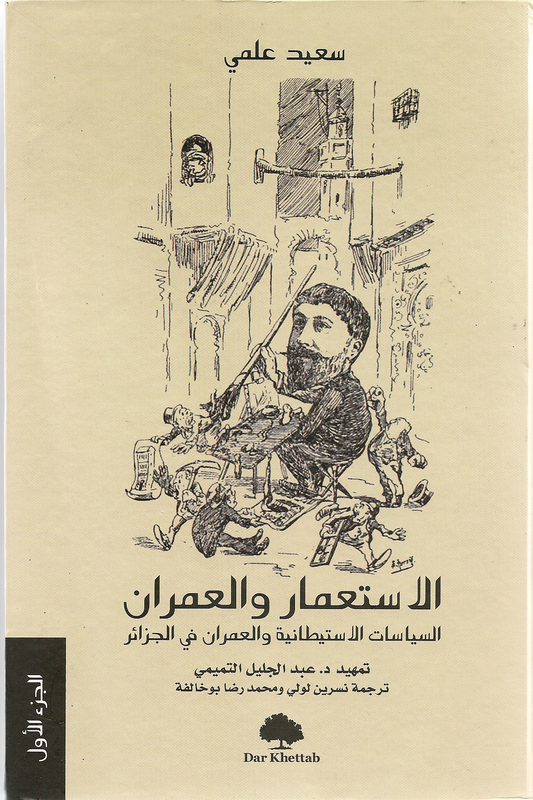
Among the works that have received support from the Algerian Ministry, Colonialism and urbanism (Almi S. 2013). This book deals precisely with the French colonial urbanism in Algeria in a comparative perspective as, under the urban model chosen, the dialogue is unevenly convened.

At the origin of this book there was the will to understand the ins and outs of the Algerian urban situation. So we had to find the necessary keys to the analysis and interpretation of this situation by identifying its major conceptual frameworks. This choice caused two methodological consequences. First, the need for what Michel Foucault would have called "an archeology of urban initiatives", going back to the beginnings of the colonial era.

To escape the ideological interpretations carried by the historiography on the French presence in Algeria, I could not do otherwise than by directly grasping the sources of information, drawing on first-hand documents.

Then there was the desire not to separate these processes from the cultural context (political, economic, social, and epistemological), in which they were developed. In other words, I had to become a historian, or at least acquire a minimum of skills in this field.

The systematic reading of the colonial literature and local news media showed three major ideological or cultural currents, respectively under the military policy of the conquerors, the Fourierism and the Saint-Simonism. The historians curiously have lost sight of the importance of these last two doctrines appeared very early in Algeria. So they neglected their role in the genesis of two main principles: assimilation, initiated by the Fourierists and appropriate by the settlers, and the association, introduced par the Saint-Simonians.

For its part, the role of the military administration is generally observed through the prism of one armed expeditions and war campaigns.

However, this role was, after all, different. It was certainly dominant, but "protector". And the civil order was, paradoxically, more repressive towards Muslims than the military order. In other words, behind the apparent homogeneity of colonialism, we can discover a kind of "heterogeneous", as written by Michel de Certeau in his “historiographical operation” (Certeau M. de 1975).

The three ideological principles in question: assimilation, association and protective domination, helped to understand the diversity of colonial policies adopted before providing a clue to think heterogeneity observed in urban planning procedures with Le Corbusier, Henri Prost and Tony Socard, at the head of the three different tendencies (functionalism, culturalism and regularization).

So I was taken to confront, term by term, trends in the respective fields of development (development and human settlements) and the colonial policy. And between each other, a curious analogy was noted.


Digressions on the city and urbanism

Before examining the marks printed by the three trends observed in the Algerian urban space, it is appropriate to question the meaning of the words « city » and « urbanism ».

Everyone agrees that only the word « city » remains. It continues to point out something that does not fit him anymore. Urban life that profiles an ideal of civilized existence, pleasant relationship between men and their space, is not characteristic of our cities today. Civility, courtesy, politeness, friendliness, solidarity, sociability, conviviality... urbanity fascinates. It still feeds an imaginary that only some old centers or neighborhoods continue to support or to wake in the conscience and feeling.

Conversely, the life of "cities" afflicts and causes controversies and debates. Everywhere we denounce its excesses and inhuman character. Certainly, the city is not what it was.

In 1994, a big exhibition was dedicated to it at the Centre Georges Pompidou in Paris (La ville, art et architecture en Europe, 1870-1993, 1994). Designed around a confrontation of varied looks of artists (painters, photographers and filmmakers) and practitioners (architects and planners), the meeting resumed serious reflection. Equally legitimately, Algeria now poses the problem and submit it for discussion.

Its "urban" setting indeed suffers from many dysfunctions.

In French, "ville" comes from Latin, then from the Italian word of “villa” (which takes its name from the casa di villa), i.e. farm or rural area, which have generally been the source of the Medieval towns.

The urbs and civitas Latin words are often raised about the antique city.
Urbs designated the physical environment, built and inhabited by a
civis community (citizens, members of a city). Civitas designated these citizens themselves, as they were an organized group socially, politically and religiously (Fustel de Coulanges N. D. 1948). Civis led to civitas, then, in the 11th century, it gave "cité" (city) and, in the 13th century, it gave citeien (inhabitant of a city). Civitas has generated in turn the Italian words città, cittade and cittadino (inhabitant of the city) which were borrowed from the French citadin, the Spanish ciudad and the Portuguese cidade. The cittadella (citadel, generally a small city surrounded by a fortification) is also a derivative of civitas.

The political dimension conveyed by the notion of civitas is crucial. Latin politicus, taken from the Greek politikos which came from politês (from the city, from the State, or citizen), itself derived from polis (city or town as a political body) indeed refers to civitas .

What about the Muslim city ?

During the French colonial presence in Algeria, the art historian Georges Marçais proposed Western planners meditation solutions that the Muslims had made to the development of their cities instinctively or traditionally. Indeed, in the Arab-Muslim culture, it never existed specialized texts for structuring the urban spaces or to condition them. Marçais stressed this specificity, but noted that the Muslim city was still based on the mosque, "essential body of worship, religious and political center of early Islam". Political life such as knew the Greek and Roman cities was foreign to it, he said (Marçais G. 1940).

Let us be back to the etymology. The word "civil", borrowed in 1290 to Latin civilis (which is relative to the citizen, to his rights and to the city), is no stranger to "civilization". And in political philosophy, civilis is a translation of the Greek politikos.

So, City, state, citizen, political, civil and civilization have however a semantic relationship with the Arabic terminology. Indeed, the term al hadhara (الحضارة)) covers both civilization and urbanity, and al hadhari (الحضاري) denotes the city-dwelle, but also the Civilized.

It is the same with madina (مدينة) (city) which may be substitutated with bilad (بلاد) or balad (بلد) (derived: baladya, city or municipality). Now, if madani (adjective, derivative of madina) appoints what is secular, city, urban, lay or civil, (mass'oulya madania: liability; canoun madani: civil law), bilad and balad mean country or territory. The French term "bled”, which is a translation of an impairment recorded in colloquial Arabic of North Africa, also designates inland, countryside, country and place or any remote village at the same time.


Urbanism and civilization

In the West, the verb "civilize" and the adjective or participle "civilized" mean, since the 16th century "(make) able for life in society", and, by a shift in meaning, "get a (human community) to a state of higher material development, intellectual and social". Then, breaking with the idea of ​​ historical process "advanced" progress, which is marred of a certain ethnocentrism, we use the terms "evolution" and "culture" (the plural “cultures” is more used from the 19th century).

In the Arab-Muslim culture, hadhari indicates which is urban and everything related to civilization. For Ibn Khaldun for example, al hadhara defines action to settle in the city. That is, specifically, the transition process from the Bedouin life (badawi: nomadic and badiya: part of the dry peri-Mediterranean steppe where the tribes of nomadic pastoralists do live and move) and village life (although village translates into qaria) to the city sedentary life. In short, civilization is installation in cities and material improvement of the live. In his Prolegomena there are two fundamental concepts: umran and assabiya. Umran (عمران) means both civilization, social organization and state. It is also the science that concerns the rational study of "natural sociability", the science which allows to understand the mechanism of historical behavior, within its general context.

If in the Middle East, “urbanism”, given as the equivalent of town planning or urban planning, is sometimes translated into takhtit al mudun, takhtit hadhari, or handasa(t) imariya, takhtit umrani, takhtit umran al-mudun, handasat al- mudun, tanthim al-mudun, in the Maghreb preference seems just go to umran.

This uncertainty vocabulary reflects the vagueness that characterizes the planning practice and partnership projects envisaged in the Arab-Muslim world today. But the situation is far from being its own. It is general. Societies have changed, but the words have remained the same; they did not follow: we always talk about town, city, urbanity ...
The explanation is fundamentally in the breakdown operated in the ancestral balance between
urbs and civitas and their divorce..

Everywhere, there is the advent of "urban". So that beyond the inflation that accompanies this terminological inflation (we talk fluent conurbation, agglomeration, metropolis, megalopolis, technopolis, urban area and region area...), the substantive " urban " itself is now accepted.


Advent of urban

Until the beginning of the Industrial Revolution, the urbs/civitas adjustment, arranged harmoniously, made the city. Since then, almost everywhere on the planet, we see the same phenomenon: break between content and container, urbs and civitas.

The traditional separation between town and campaign as we could still perceive in France in the 14th century, for example, is practically inexistent. Until then, there was urban space, usually bounded by walls and perfectly identifiable, on one side, and farmland, forest and livestock on another one (Cf. Le Roy Ladurie E. 1988). But in the 14th century, the word "city", competed with the term "town" meant only the central part (e.g. the city of London) or the oldest part of the city. Then the word was gradually losing its meaning.

As città term in the Italian language and culture, it passed a specific meaning in a vague and general sense.

It is now necessary, to designate a field or a particular area, to accompany it by denotative qualifiers: University City, Science City, working city, dormitory city, garden city...

In the Arab-Muslim world, the situation is the same. Colonization, yesterday, and international exchanges, today, are the cause of the new spatial pattern of human settlement. As for the "city", the word madina is equally applied to historic sites and to any urban area.

So much so that a plurality terminology is used to describe the urban practices. This is an emblematic sign of the cission. Indeed, as if to conjure this upheaval, approaches and designations of the new urban reality are increasing.


Urbanism…

In the 19th century, to name the practice of building urban space, use is made of neologisms. In 1867, the Spanish engineer Ildefondo Cerdá introduced the term "urbanizacion" (Cerdá I. 1979). Contemporary of Haussmann, Cerdá is the designer of the regulator plan of Barcelona, but he is especially the first theoretician of urbanism considered as a science.

In French, the word "urbanisme" appeared for the first time in 1910 in Switzerland (Clerget P. 1910). Since then, it means the discipline for the material and functional urban development, the expansion process of urban space and the organization of its population.

But by adding the suffix "ism" to the radical "urban", planning is erected to the status of science whose privilegied object is space as a material substance, neutral object, malleable and reproducible. There is so to say predominance of physical reality (urbs) on the social, human and political reality (civitas and polis).

With its new status, the modern practice of spatial planning thus emptied of its substance its purpose. However, as we have seen, the polis was historically a community of individuals before being a "space" (a concept understood in the sense of conceptual and material entity, specific to the Western world).

For the Greeks, for example, the city was first citizens themselves. The city of Athens did not exist as such; it was the city of the Athenians. The citizen condition and the idea of the political body prevailed. And in the culture and the imaginary Arab-Muslim, city is a community before being a built space. Space is secondary to human relations. Hence, presumably, the absence in Arabic exact equivalent to the concept of “space” (in the architectural and urban sense) as it exists in the Western imagination. ) In the French-Arabic dictionaries, the word 'space' is usually translated as massafa (surface, area), fush'a (extent or area), fadhaa (universe), faragh (empty), saaha (place), makane (place, site), oues'e (wide), hawa'e (air) or heiz, rihaba, madjal, madaa... None of these terms denotes it rigorously.

Urbanification
The term “urbanification” has been proposed by Gaston Bardet, to designate the spontaneous phenomenon of urban development, as opposed to 
the organized form implied by urban planning.
Urbanology

This word has been coined by Marcel Cornu and taken especially by Paul and Françoise Claval (Claval P. & Claval F. 1981). In an article published in 1969 in Les Lettres françaises andentitled "The need for an ”urbanologie”", Marcel Cornu said:"We propose to call 'urbanology' all the research and studies whose field is to be urban space, that is to say everything about the growth of cities. The urbanologie would be the science of the city".

Two other words are entering the French jargon on the urban space:”urbanistique” and “urbistique”.


Urbanistique

In the early 1950s, the Italian anarchist architect and urban planner Carlo Doglio linked the garden city to anarchism and criticized Ebenezer Howard to aim a capitalist ideal of philistine. In a series of articles published in the journal Volontà of Naples, he defines the “urbanistique” as how to respond to the needs and aspirations of the human species particulary by focusing on social (Doglio C. 1974).

The term was taken in a different direction by Henry Raymond (1977) and students who do not consider the city as an agglomeration turning around a unique historical pole, but as an urban space as articulated according homogeneous and specific areas, functionally distributed and communicating with each other.


Urbistique 

Two keywords are characteristic of urbistique, whose approach is based on systemic: "urban system" and "management". This neologism was forged by combining the Latin "urbis" and the suffix "tique" alluding to the ICT (information and communication technologies) which is made extensive use.

At a time when the substantive "urban" often prevails over the word "city" because of the anachronism of that designation, “urbistique” aims to give back to the urban area a certain unity. Its management will be global and its policy wants to be transverse. Any fragmented approach is banished.

Consultation, systems analysis and holistic approach to urban planning problems by using the amount of information and limiting the expansive 
development, these are the watchwords of the urbistique. The word is used since thirty years mainly in Switzerland, where it extends, through
the Competence Centre Urbistique (CREM) of Marigny, and in Canada.

But these four terms (urbanification, urbanology, urbanistique and urbistique) fail more or less to enter into common usage.


Functionalism and culturalism in urban planning

More than half a century after gaining independence, Morocco, Algeria and Tunisia are still living in the shadow of three major planning principles from their French colonial past: functionalism, culturalism and, to a lesser extent, regularization.

Thfunctionalism came from the modern movement of CIAM (Congrès Inernationaux d’Architecture Moderne/International Congress of Modern Architecture) and its Athens Charter, which extended the ideas of some protagonists of progressive thinking in the XIXe century such as Robert Owen in England, Charles Fourier in France…

As for the functionalism, the culturalist principles are inherited from a backward-looking movement whose origins date back to the 19th century, with  Augustus Pugin, John Ruskin, William Morris, Ebenezer Howard, Raymond Unwin, in England, Camillo Sitte, in Austria… (Cf. Choay F. 1965). Functionalism in architecture and urban planning is based on a universal ideology of progress. It advocates strict adaptation of form to function and rigorous separation of urban functions. It emphasizes values of economy, hygiene and movement and uses technical and industrial know-how to create a new space to meet anticipated needs which are assumed to be the same the world over: to live, work, travel and enjoy entertainment. Thus functionalism does not take into account the past or local, regional or national specificities.

Conversely, the culturalist approach focuses on cultural aspects of society and advocates a graded organization of space, following a federative scheme. It is marked by a strong nostalgia for the old social and cultural communities.

North African cities are still dependent on that planning models.

After a period in which their inspiration was mainly European, North African developers are turning more and more (and appeal) to international urban development firms, which practice the policy of universal models, no taking into account local or regional peculiarities. This use has been made possible thanks to anchoring functionalist and culturalist principles in political North African development. These principles were supposed universally valid. But, in Europe today, there is a failure of functionalist and culturalist models.

Question: these North African countries, do not they benefit from inspiration rather the principle of regularization whose the realistic vision contrasts with the utopian nature of functionalism and culturalism ?


Regularization, founding principle of the French school of urbanism

The regularization was implemented by the so-called French school of urbanism (whose the SFU, French Society of Planners, is a direct emanation still alive) in the early 19th century. It was applied between the two wars through PAEE (Plans d’Aménagement, d’Embellissement et d’Extension/Development, Embellishment and Extension Plans), then it was quickly abandoned in 1939.

Originating from the four major influences: the Ponts et Chaussées, the Musée Social and the Moroccan colonial experience under Lyautey, and to an extent, British culturalism, the French School of Urbanism can be mainly characterized by its realism and its distance from any domineering ideology. These two elements are indeed what the functionalist and culturalist models of modern urbanism lack, in spite of their decisively scientist objectives, which still prevail worldwide. Since it is linked with value systems, urbanism cannot in any way prevail itself to be a rigorous science. It sand cannot claim to be anything but a praxis, i.e. a group of human activities potentially able to transform the natural environment or to change social relationships. The French school of urbanism has been so convinced ever since its birth in the early 20th century, combining the technical, economic, social and cultural dimensions in its project of regularization of urban space. Meanwhile, within the French school of urbanism, the French word "urbanisme" enters the language. Also within the framework of the French school, was born in 1911 the SFU whose such founding members as H. Prost, L. Jaussely, D-A. Agache, J-M. Auburtin, A. Bérard, J-C-N Forestier, E. Hebrard, E. Hénard, L. , A. Parenty, E. Redont are prominent members of the French school, along with H. Cornudet, G. Risler, J. Siegfried...from the Musée Social.


From dialogue to trialogue, through regularization

ln the fields of edification, with a general acceptance of the term, the requierement of dialogue can be found mainly in the writings of Leon Battista Alberti, the father of modern in the 15th century.building. For him the three specific levels of edification are necessity (necessitas), pleasure (voluptas) and above all convenience (commoditas) where the dialogue between the planner and the client is of first and foremost importance (3).

With the appearance of the Industrial Revolution occurs undeniably a complexification of the process of edification. The entrepreneurs or planners are then much more numerous than when Alberti was alive, and when his dialogical axiom could come down to the relationship between an architect and his client

As from the mid-nineteenth century, the requirements related to edification become more various. Haussmann becomes well aware of it. The Prefect of Paris realises the necessity to extend the consulting and besides to regard the town not as a collection of separate parts, as in the traditional road widening schemes, but as a whole.

Such is what a part of the principle of regularization consists in, which is what today's «synthesis of haussmannian thought » is called (Choay F. 1969). The remaining part consists more precisely in the idea of an unbreakable link between the past, the present and the future. Such is not the case in the functionalist and culturalist theories of contemporanean urbanism of haussmannian regularization, whose protagonists are no other than Ildefonso Cerdá (1979) on the one hand and both the Austrian Camillo Sitte (1996) and the British Ebenezer Howard (1998) on the other. The former of these theories is indeed almost entirely turned to the future, whereas the latter focuses on the past.

A third part can be defined in the characterisation of hausmannian regularization: this one deals with geography. No town can be separated from its region with which it is inter-related.

Oddly enough, the regularization-functionalism-culturalism trilogy of urban thought in the late half of the 19th century are to be found integrally in Algiers from 1930, on the occasion of the hundredth anniversary of colonisation. Prost, le Corbusier and the couple Bardet-Socard are respectively its main leaders and representatives.


Enforcement of the principle of regularization in Algiers(9)

The three principles of extended consulting, historical dimension of town-planning and geographical determining factors are all present in the process of urbanisation of Algiers, as they are in the one of all the major Algerian towns to which is enforced the Law of March 14, 1919 on the organisation of planning, enhancement and extension (PAEE). This Law enables a new way of intervening on urban space. The new proceeding, which originated from the group of professionals and the think-tank who started working together as from 1910 in the framework of the French school of urbanism, aimed at the optimisation of urban space. As a matter of fact, this is just the logical result of the haussmannian regulatory tradition, to which has been added by the fruit of the experience acquired in Morocco in a colonial context under the rule of Lyautey, the works of a visionary engineer called Eugène Hénard and the socially oriented reflexions of the Musée Social.

The new regulatory viewpoint is indeed made up of three major orders: geographical, historical and consensual. Each of these orders is itself strongly connected to three vital elements.

- Geographical order: the town, its neighbourhoods and its regions

By means of its PAEE, the town of Algiers endowed itself, for the first time in 1929 with an overall scheme conceived on the scale of its whole territory. This PAEE is even aimed at being a genuine leading plan, upon which will depend all the following projects. Conversely, this town plan very quickly reveals its regional links, in other words the necessity of a regional plan whose conception started as early as 1930. It so happens that this scheme was already present in the law of March 14, 1919 and in the decree of October 24, 1925 which made this law enforceable in Algeria. The surrounding towns or villages were allowed to « have only a single general scheme for every extension or town-planning unlikely to be achieved in the short term », as is stated (Official Journal, October 31,1925). Thus the town of Algiers will not wait for the votes of the Law of July 25, 1935 on regional plans to resume the study of its regional planning.

- Historical order: the techniciens, the colonizers and the colonizing

As if it were a triptyque, past, present and future are more than closely linked in the regulatory approach of urban space. ln addition to the general rules which must be enforced to every town endowed with a PAEE, there are still specific clauses adapted to every one of them and which underline its « own character » (Danger R. 1933). ln Algiers, five large areas set the way buildings should be constructed and how many people should live there, in accordance with the way these buildings should be lived in, by what category of people and by people having what kind of job. The fifth one, covering the historical quarter of the Casbah, was added to the list in a correction made in 1934. This correction endows the old Muslim quarter with a specific regimen aimed at preserving its general features. It goes under a special rule and involves very severe conditions of conservation.

- Consensual order: the political power, the technicians and the users

Both the historical and the geographical orders enable the regulatory proceedings to benefit from a realism which both the functionalist and the culturalist theories are deprived of. There is additional profit: a consensuous will be based on a sum of information. The vote of the PAEE goes along, as early as 1929 with the birth of the «Société des Amis d'Alger », an association which focuses on a wide debate on town-planning and on getting the inhabitants involved in the development of their town. This repreents a huge attempt at making people aware at what was at stake thanks to numerous newspapers either local or metropolitan. Lectures to which leading figures were invited, surveys focusing on the planning of Algiers and two major exhibitions of architecture and town planning were also set up so as to make Algiers the setting of an unprecedented debate. Meanwhile, a large work of documentation and research was launched. Mentioning “Algiers. Urban geographical and historical study” by René Lespès (1930), Henri Prost goes as far as saying that it is a precious tool and «a valuable introduction» (Prost H. 1929) to his plan for the development of Algiers.

Thus local history remains most valuable.

This way of thinking is incompatible with the functionalist and culturalist models which were created from scratch and applied indifferently, whatever the location, because they were supposedly easy to reproduce, on account of their given universal value. Therefore, these same models would have survived the war, benefiting from the recovery of the country, and even its independence.

The choices which were made were the easy victims of the misleading of these comforting models.

All in all, the three orders above mentioned (geographical, historical and consensuous) are all in favour of a mind-openness proper to regularization, which aims at a composed town-planning, as opposed to the functionalist and culturalist models aiming at an imposed one.


The initiative taken by the Algerian Ministry making French, English and German works available in Arabic should arouse a general craze for 
translation in the Arab world. Conversely, many works published in the language of "Dad” (
ﺿﺎﺩ) deserve to be discovered in the West. Encourage
their translation into the language of Shakespeare would give the Arabic though an international focus.
Today, the value of this thought is well established (Arkoun M. 1975) ), its place in the general history of thought and culture must stop take it
problematic aspect that gives it an uncertain status.


_________

(1) This is Banipal (London), ÇEVIR (Istanbul), European Council of Literary Translators Associations (CEATL) (Brussels), Escuela de Traductores de Toledo (Toledo), King Abdul Aziz Foundation (Casablanca), Next Page Foundation (Sofia), Goethe Institute (Cairo), Index Translationum (UNESCO), the Arab World Institute (Paris), French Institute for the Near East (Damascus, Beirut, Amman, Ramallah), IREMAM (Research Institute and Studies on the Arab and Muslim World) (Aix-en-Provence), Literature Across frontiers (Manchester), Swedish Institute Alexandria (Alexandria) and Università degli studi di Napoli Orientale (Naples).


References


Alberti L. B. (2004) L’art d’édifier, Paris: Seuil, (1st ed. 1485).


Almi S. (2002) Urbanisme et colonisation. Présence française en Algérie, Sprimont: Pierre Mardaga.


Almi S. (2013) الإستعمار والعمرانالسياسات الاستيطانية والعمران في الجزائر: سعيد علمي Algiers: Dar Khettab, 2 volumes.


Arkoun M. (1975) La pensée arabe, Paris, PUF, Que sais-je ?, 128 p. English translation, Arab Though, New-Delhi: S. Chand, 1988.


Braudel F. and alii (1963) Le Monde actuel. Histoire et civilisations, Paris, Belin. The content has been partly incorporated in his Grammaire des civilisations (1987), Paris: éditions Arthaud.


Cerdá I. (1979) La Théorie générale de l’urbanisation, Paris: Le Seuil, Paris, 1979 (1st ed. 1867)


Certeau M. de (1975) L'écriture de l'histoire, Paris: Gallimard.


Chevalier M. (1832) Religion saint-simonienne. Politique industrielle. Système de la Méditerranée, Paris: aux Bureaux du Globe.


Choay F. (1965) L’urbanisme, utopies et réalités. Une anthologie, Paris: Ed. du Seuil.


Choay F. (1969) The modern city: planning in the 19th century, New York: Braziller.


Claval P. & Claval F. (1981) La logique des villes : essai d'urbanologie, Paris: Litec.


Danger R. (1933) Cours d’urbanisme, Paris: librairie de l’enseignement technique Léon Eyrolles.


Doglio C. (1974) L’equivoco della città giardino, Firenze: CP editrice.


Glasson Deshaumes G. & Aubarell G. (2012) Etat des lieux de la traduction dans la région euro-méditerranéenne, Paris: Assemblée transeuropéenne pour la traduire entre les cultures. Full version available in Arabic, French and English on http://www.euromedalex.org/sites/default/files/TE-TEM-FR3-web-g.pdf.


Godard A. (2001) Le dialogue à la Renaissance, Paris: PUF.


Fustel de Coulanges N. D. (1948) La Cité antique. Etude sur le culte, le droit, les institutions de la Grèce et de Rome, Paris: Hachette (1st ed. 1864).


Haussmann E. (baron) (2000) Mémoires, Paris: Editions du Seuil (1st ed. 1890-1893).


Howard E. (1998) Les cités-jardins de demain, Paris: Editions Sens Tonka. (1st ed.: To Morrow, a Peaceful Path to Social Reform, London: Swan, Sonnenschein,1898).


Jacquemond R. (2007) (ed.) La traduction des sciences humaines et sociales dans le monde arabe contemporain. Actes du colloque organisé par la Konrad-Adenauer-Stiftung et la Fondation du Roi Abdul-Aziz Al Saoud pour les Etudes islamiques/Proceedings of the symposium organized by the Konrad-Adenauer-Stiftung and the Foundation of King Abdul Aziz Al Saud for Islamic Studies, Casablanca (25-27 octobre 2007), Ed. Fondation du Roi Abdul-Aziz et la Konrad Adenauer Stiftung.Koyré A. (1966) Études d’histoire de la pensée scientifique, Paris: Presses Universitaires de France.


Le Roy Ladurie E. (ed.) (1988) La ville des temps modernes. De la Renaissance aux Révolutions, Paris: Éd. du Seuil.


Lespès R. (1930) Alger. Etude de géographie et d'histoire urbaines, Paris: Alcan, Coll. du Centenaire de l’Algérie.


Lewis B. (1964) The Middle East and the West, Bloomington: Indiana University Press & London: Weidenfeld & Nicolson. Reissue (1994) The Shaping of the Modern Middle East, New York-Oxford: Oxford University Press. French translation (1995) La formation du Moyen-Orient moderne, Paris: Aubier.


Raymond H. and alii (1977) Urbanistique et société baroques, Paris: Ministère des Affaires Culturelles/D.G.R.S.T./IERAU.


Sitte C. (1996) L’Art de bâtir les villes. L’Urbanisme selon ses fondements artistiques, Paris: Editions du Seuil (1st ed. 1889).


La ville, art et architecture en Europe, 1870-1993 (1994), Paris: Centre Georges Pompidou.


Official Journal, October 31, 1925.


_______


Almi S. (2008) Trialogue and Regularization. Reappraisal of an Abortive Experience. Trialogue et régularisation. Retour sur une expérience avortée. Urban Trialogues. Co-productive ways to relate visioning and strategic urban projects, Antwerp, Belgium 19-23 September 2007, ISOCARP.


Clerget P. (1910) L’urbanisme, étude historique, géographique et économique. Bulletin de la Société neuchâteloise de géographie,. 213-231.


Glasson Deshaumes G. (2009) Pour une politique de traduction en Méditerranée. Asylon(s), la revue des deux asiles, 7.


Huntington S. (1993) The Clash of Civilizations ? Foreign Affairs, vol. 72, n° 3, 22-49. Article transformed into a book : The Clash of Civilizations and the Remaking of World Order, New York: Simon & Schuster, 1996. French translation: Le Choc des civilisations, Paris: Odile Jacob, 1997.


Lewis L.(1990, September) The Roots of Muslim Rage. The Atlantic Monthly, Boston, vol. 266.


Marçais G. (1940) L’urbanisme musulman, Revue africaine, n° spécial.


Prost H. (1929, December 14) Entretien. Le Journal Général Travaux Publics et Bâtiment, 393.


Saïd E. W. (2001, October 26) Le choc de l’ignorance. Le Monde.

benefits and interest.

Algerian urbanism tested
15 mai 2015

Translation in the Mediterranean basin

Translation in the Mediterranean basin: benefits and interest.
Algerian urbanism tested


Abstract


Arab countries have a lot to gain from the translation operation. The initiative taken by the Algerian Ministry of Veterans Mojahedin making different French, English and German works available in Arabic should arouse a general craze for translation in the Arab world. Conversely, many works published in the language of "Dad” (ﺿﺎﺩ) deserve to be discovered in the West. Encourage their translation into the language of Shakespeare would give the Arabic though an international focus.

Today, the value of the Arabic thought is well established; its place in the general history of thought and culture must stop take it problematic and give it an uncertain aspect or status.

The determining role of translation in access to knowledge, fundamental condition for economic, social and cultural development of a country, is evident as well. Translation promotes dialogue and this is one of the master pieces of urban planning where we even speak about “trialogue”. By scrutinizing the Algerian town planning, as it has been bequeathed to us by the French colonization, we realize how much openness to the Other is inescapable.


Keywords
Algeria, Arabic though, regularization, translation, urbanism,


By

Saïd ALMI

Anthropologist, Sociologist of the built space, Ph.D. in Town planning

Town planner SFU (French Society of Planners) (Paris). In charge of Renewable energies and North Africa.Member of the FTERSI (Temimi Fundation of Scientific Research and Information) (Tunis) and APA (African Planning Association) (South Africa).


Summary


Where the translation is in Mediterranean ?

Dialogue and urbanism

Colonialism and urbanism

Digressions on the city and urbanism

Urbanism and civilization

Advent of urban

Urbanism…

Urbanification

Urbanology

Urbanistique

Urbistique

Functionalism and culturalism in urban planning

Regularization, founding principle of the French school of urbanism

From dialogue to trialogue, through regularization

Enforcement of the principle of regularization in Algiers 


Translation in the Mediterranean basin: benefits and interest
Algerian urbanism tested


Tribute should be paid to the Algerian Ministry of Veterans Mojahedin which, on the occasion of the fiftieth anniversary of the accession of Algeria to independence, has made possible the translation into Arabic of a number of scientific and academic works. Arabic-speaking readers enjoy.

In general, Arab countries have everything to gain from the translation operation.


Where the translation is in Mediterranean ?

In 2010, Transeuropéennes launched with the support of the Anna Lindh Euro-Mediterranean Foundation for the Dialogue between Cultures, the French Ministry of Culture and Communication, the Regional Council of Ile-de-France and the French Institute and in collaboration with several euro-Mediterranean partners (1), an extensive survey of translation across the Mediterranean.

Numerous studies have focused on the actors concerned (authors, translators, publishers, booksellers, librarians, critics and support organizations) and the flow situation and issues, the dissemination and receipt of the translation and on training translators, it appears a state of unprecedented places: the Mediterranean Basin accuses a large deficit in this area. Large qualitative and quantitative differences were noted in the chain of translation between the two sides (Glasson Deshaumes G. & Aubarell G. 2012). The situation is so severe that, during the presentation of the final report in June 2012 in Brussels, the Executive Director of the Anna Lindh Foundation, Andreu Claret, rightly spoke of a "clash of ignorance" (3). The term seems to have been dictated by Edward Said, who, in reaction to the crazy idea of a "clash of civilizations" of American ideologue Samuel Huntington, has denounced the stigmatizing position. Indeed, as Bernard Lewis who influenced him, Huntington, strongly opposes the West to Islam, forgetting the internal plurality in each of the two "blocks" and their respective heterogeneity. 
Andreu Claret therefore called his wishes in a clear improvement of the situation between the different Mediterranean languages (Glasson Deshaumes G. & Aubarell G. 2012).

The implementation of the conclusions and recommendations of the study may be able to open the way for a new Euro-Mediterranean era, based both on a common identity and cultural diversity. The Saint-Simonians have been the first to have understood. Early in the19th century, they have indeed advocated the "union in difference" and advocated to do precisely the Mediterranean a "nuptial bed of the East and the West" (Chevalier M. 1832).

Beyond linguistic and cultural question, the entire political and geopolitical sphere is well underway.

First, the determining role of translation in access to knowledge, fundamental condition for economic, social and cultural development of a country, is well established.

Indeed, Greek thought has penetrated the Arab-Muslim world through translations which have experienced their high level in the 9th century. The Caliph Ma'mun encouraged the initiative by setting up Bayt al-Hikma. Even today, the level of activity and rigor and scholarship that prevailed in this House of Wisdom remains unique in that same Arab-Muslim world. The first major translations date back to the early 8th century, when Salim Abu-l-Ala, Iran's secretary of the Umayyad Hisham, attacked various epistles published from Aristotle to Alexander, before, thanks to the development of papermaking in 762, translations of the Greek philosophers did take an unprecedented scale. So well in fact that the historian of science, Alexandre Koyré, said later, to the chagrin of some Westerners, "It was the Arabs who were the teachers and educators of the Latin West" (Koyré A. 1966. Underlined by the author).

But today it is quite different. In his presentation of the "Plan Ibn Ishaq Hunayn" in 2006 in Paris, Abdessalam Cheddadi denounced the delay in the translation into Arabic. He said the failure "prohibits the Arabic language (...) to be on a par with minimum level normally required in knowledge and modern creation" (cited by Glasson Deshaumes G. 2009). And at a recent symposium on the translation into human and social sciences, he added: "no discipline offers in Arabic all the constituent elements of a disciplinary field", knowing that translation does not concern only words but whole strands of thought (Jacquemond R. 2007). Therefore, translation is a working background that affects the whole of "episteme" of a society or era. The ignorance of a language is therefore up to a misunderstanding of an entire culture or a civilization. About ignorance, Edward Said (2001) comdemned the misunderstanding and confusion experienced by some ideologues like Bernard Lewis and Samuel Huntington. Considering the "civilizations" and "identities" as closed entities without plurality or internal contradictions, these argue the idea of a "clash of civilizations" and radically oppose Islam and the West, defined as "Judeo-Christian civilization."

In 1964 , the Israeli-American orientalist, originally from England, an expert on Turkish civilization, Bernard Lewis, addressing the issue of the Middle East, draws on the work – far richer and more complex - of Fernand Braudel (1963) to establish his theory of the antagonism between civilizations and launch his famous formula. According to him, the crisis in the Middle East is not due to a dispute between States but to a "clash of civilizations" (Lewis B. (1964). Huntington refers to Lewis (1990) and publishes an article, then a very controversial book (Huntington S. 1993).

This antagonist vision must be fought and outdated by creating the conditions for dialogue. Among these conditions, the translation is not the least. The Arab world will benefit because most of its scientific disciplines show an almost total failure in terms of components, frameworks and concepts, specific to constitute a disciplinary field. Urbanism is one of them.


Dialogue and urbanism

Dialogue means exchange of words between two or more people. As part of the rediscovery movement and imitation of antiquity, the dialogue was present among all humanists and all the great intellectual debates of the Renaissance. Thanks to the game representation of interlocutors, it brought a "possibility of critical distance and questioning of the powers of speech" (Godard A. (2001).

In urban planning, dialogue plays a key role. Prior to any work on the Parisian urban area in the second half of the 19th century, for example, Prefect urban planner of Paris, Haussmann, was still engaged in a wide consultation.

By the mid-nineteenth century, requirements for planning were going to be diversified and the building process more complex. So the heirs of Haussmann’s method worked to overcome the dialogue in favor of the "trialogue" they endow three properties: long-term vision, create conditions and broad participation as possible.

Dialogue and trialogue have their origins in a process established by Haussmann himself, the " regularization ": a term invented by the Prefect urban planner of Paris (Haussmann E. 2000).

The principle of regularization, whose Haussmann, like Napoleon III, his protector, influenced by the thinking industrialist Saint-Simonian, measured the importance, aims to optimize the urban space using modern techniques and adapt historic new needs generated by industrial civilization, without sacrificing the legacy of the past.

As for the regularization, the trialogue approach includes three levels, comparable: historical (an inseparable link is established between the past, present and future), geographic (any city is inseparable from the region with which it carries on interaction) and consensus (based on the amount of information). The articulation of these orders is expressed in a formula characteristic of the regularization: the general rules applicable to all cities need to add specific provisions for each city treated concrete (Almi S. 2008).


Urbanism and colonialism

Trialogue and regularization: both these neologisms were created more than a century apart. They refer to two groups of approaches or oddly similar intentions. One and one summons the otherness: the contest of the Other is indeed erected in order.

To illustrate these concepts trialogue and regularization, consider the case of the cities of Algieria during the French colonial period. The domination of the Other was, there, a major factor. So this environment is an ideal setting for examining the question of otherness, central idea in our subject.

Among the works that have received support from the Algerian Ministry, Colonialism and urbanism (Almi S. 2013). This book deals precisely with the French colonial urbanism in Algeria in a comparative perspective as, under the urban model chosen, the dialogue is unevenly convened.

At the origin of this book there was the will to understand the ins and outs of the Algerian urban situation. So we had to find the necessary keys to the analysis and interpretation of this situation by identifying its major conceptual frameworks. This choice caused two methodological consequences. First, the need for what Michel Foucault would have called "an archeology of urban initiatives", going back to the beginnings of the colonial era.

To escape the ideological interpretations carried by the historiography on the French presence in Algeria, I could not do otherwise than by directly grasping the sources of information, drawing on first-hand documents.

Then there was the desire not to separate these processes from the cultural context (political, economic, social, and epistemological), in which they were developed. In other words, I had to become a historian, or at least acquire a minimum of skills in this field.

The systematic reading of the colonial literature and local news media showed three major ideological or cultural currents, respectively under the military policy of the conquerors, the Fourierism and the Saint-Simonism. The historians curiously have lost sight of the importance of these last two doctrines appeared very early in Algeria. So they neglected their role in the genesis of two main principles: assimilation, initiated by the Fourierists and appropriate by the settlers, and the association, introduced par the Saint-Simonians.

For its part, the role of the military administration is generally observed through the prism of one armed expeditions and war campaigns.

However, this role was, after all, different. It was certainly dominant, but "protector". And the civil order was, paradoxically, more repressive towards Muslims than the military order. In other words, behind the apparent homogeneity of colonialism, we can discover a kind of "heterogeneous", as written by Michel de Certeau in his “historiographical operation” (Certeau M. de 1975).

The three ideological principles in question: assimilation, association and protective domination, helped to understand the diversity of colonial policies adopted before providing a clue to think heterogeneity observed in urban planning procedures with Le Corbusier, Henri Prost and Tony Socard, at the head of the three different tendencies (functionalism, culturalism and regularization).

So I was taken to confront, term by term, trends in the respective fields of development (development and human settlements) and the colonial policy. And between each other, a curious analogy was noted.


Digressions on the city and urbanism

Before examining the marks printed by the three trends observed in the Algerian urban space, it is appropriate to question the meaning of the words « city » and « urbanism ».

Everyone agrees that only the word « city » remains. It continues to point out something that does not fit him anymore. Urban life that profiles an ideal of civilized existence, pleasant relationship between men and their space, is not characteristic of our cities today. Civility, courtesy, politeness, friendliness, solidarity, sociability, conviviality... urbanity fascinates. It still feeds an imaginary that only some old centers or neighborhoods continue to support or to wake in the conscience and feeling.

Conversely, the life of "cities" afflicts and causes controversies and debates. Everywhere we denounce its excesses and inhuman character. Certainly, the city is not what it was.

In 1994, a big exhibition was dedicated to it at the Centre Georges Pompidou in Paris (La ville, art et architecture en Europe, 1870-1993, 1994). Designed around a confrontation of varied looks of artists (painters, photographers and filmmakers) and practitioners (architects and planners), the meeting resumed serious reflection. Equally legitimately, Algeria now poses the problem and submit it for discussion.

Its "urban" setting indeed suffers from many dysfunctions.

In French, "ville" comes from Latin, then from the Italian word of “villa” (which takes its name from the casa di villa), i.e. farm or rural area, which have generally been the source of the Medieval towns.

The urbs and civitas Latin words are often raised about the antique city.
Urbs designated the physical environment, built and inhabited by a
civis community (citizens, members of a city). Civitas designated these citizens themselves, as they were an organized group socially, politically and religiously (Fustel de Coulanges N. D. 1948). Civis led to civitas, then, in the 11th century, it gave "cité" (city) and, in the 13th century, it gave citeien (inhabitant of a city). Civitas has generated in turn the Italian words città, cittade and cittadino (inhabitant of the city) which were borrowed from the French citadin, the Spanish ciudad and the Portuguese cidade. The cittadella (citadel, generally a small city surrounded by a fortification) is also a derivative of civitas.

The political dimension conveyed by the notion of civitas is crucial. Latin politicus, taken from the Greek politikos which came from politês (from the city, from the State, or citizen), itself derived from polis (city or town as a political body) indeed refers to civitas .

What about the Muslim city ?

During the French colonial presence in Algeria, the art historian Georges Marçais proposed Western planners meditation solutions that the Muslims had made to the development of their cities instinctively or traditionally. Indeed, in the Arab-Muslim culture, it never existed specialized texts for structuring the urban spaces or to condition them. Marçais stressed this specificity, but noted that the Muslim city was still based on the mosque, "essential body of worship, religious and political center of early Islam". Political life such as knew the Greek and Roman cities was foreign to it, he said (Marçais G. 1940).

Let us be back to the etymology. The word "civil", borrowed in 1290 to Latin civilis (which is relative to the citizen, to his rights and to the city), is no stranger to "civilization". And in political philosophy, civilis is a translation of the Greek politikos.

So, City, state, citizen, political, civil and civilization have however a semantic relationship with the Arabic terminology. Indeed, the term al hadhara (الحضارة)) covers both civilization and urbanity, and al hadhari (الحضاري) denotes the city-dwelle, but also the Civilized.

It is the same with madina (مدينة) (city) which may be substitutated with bilad (بلاد) or balad (بلد) (derived: baladya, city or municipality). Now, if madani (adjective, derivative of madina) appoints what is secular, city, urban, lay or civil, (mass'oulya madania: liability; canoun madani: civil law), bilad and balad mean country or territory. The French term "bled”, which is a translation of an impairment recorded in colloquial Arabic of North Africa, also designates inland, countryside, country and place or any remote village at the same time.


Urbanism and civilization

In the West, the verb "civilize" and the adjective or participle "civilized" mean, since the 16th century "(make) able for life in society", and, by a shift in meaning, "get a (human community) to a state of higher material development, intellectual and social". Then, breaking with the idea of ​​ historical process "advanced" progress, which is marred of a certain ethnocentrism, we use the terms "evolution" and "culture" (the plural “cultures” is more used from the 19th century).

In the Arab-Muslim culture, hadhari indicates which is urban and everything related to civilization. For Ibn Khaldun for example, al hadhara defines action to settle in the city. That is, specifically, the transition process from the Bedouin life (badawi: nomadic and badiya: part of the dry peri-Mediterranean steppe where the tribes of nomadic pastoralists do live and move) and village life (although village translates into qaria) to the city sedentary life. In short, civilization is installation in cities and material improvement of the live. In his Prolegomena there are two fundamental concepts: umran and assabiya. Umran (عمران) means both civilization, social organization and state. It is also the science that concerns the rational study of "natural sociability", the science which allows to understand the mechanism of historical behavior, within its general context.

If in the Middle East, “urbanism”, given as the equivalent of town planning or urban planning, is sometimes translated into takhtit al mudun, takhtit hadhari, or handasa(t) imariya, takhtit umrani, takhtit umran al-mudun, handasat al- mudun, tanthim al-mudun, in the Maghreb preference seems just go to umran.

This uncertainty vocabulary reflects the vagueness that characterizes the planning practice and partnership projects envisaged in the Arab-Muslim world today. But the situation is far from being its own. It is general. Societies have changed, but the words have remained the same; they did not follow: we always talk about town, city, urbanity ...
The explanation is fundamentally in the breakdown operated in the ancestral balance between
urbs and civitas and their divorce..

Everywhere, there is the advent of "urban". So that beyond the inflation that accompanies this terminological inflation (we talk fluent conurbation, agglomeration, metropolis, megalopolis, technopolis, urban area and region area...), the substantive " urban " itself is now accepted.


Advent of urban

Until the beginning of the Industrial Revolution, the urbs/civitas adjustment, arranged harmoniously, made the city. Since then, almost everywhere on the planet, we see the same phenomenon: break between content and container, urbs and civitas.

The traditional separation between town and campaign as we could still perceive in France in the 14th century, for example, is practically inexistent. Until then, there was urban space, usually bounded by walls and perfectly identifiable, on one side, and farmland, forest and livestock on another one (Cf. Le Roy Ladurie E. 1988). But in the 14th century, the word "city", competed with the term "town" meant only the central part (e.g. the city of London) or the oldest part of the city. Then the word was gradually losing its meaning.

As città term in the Italian language and culture, it passed a specific meaning in a vague and general sense.

It is now necessary, to designate a field or a particular area, to accompany it by denotative qualifiers: University City, Science City, working city, dormitory city, garden city...

In the Arab-Muslim world, the situation is the same. Colonization, yesterday, and international exchanges, today, are the cause of the new spatial pattern of human settlement. As for the "city", the word madina is equally applied to historic sites and to any urban area.

So much so that a plurality terminology is used to describe the urban practices. This is an emblematic sign of the cission. Indeed, as if to conjure this upheaval, approaches and designations of the new urban reality are increasing.


Urbanism…

In the 19th century, to name the practice of building urban space, use is made of neologisms. In 1867, the Spanish engineer Ildefondo Cerdá introduced the term "urbanizacion" (Cerdá I. 1979). Contemporary of Haussmann, Cerdá is the designer of the regulator plan of Barcelona, but he is especially the first theoretician of urbanism considered as a science.

In French, the word "urbanisme" appeared for the first time in 1910 in Switzerland (Clerget P. 1910). Since then, it means the discipline for the material and functional urban development, the expansion process of urban space and the organization of its population.

But by adding the suffix "ism" to the radical "urban", planning is erected to the status of science whose privilegied object is space as a material substance, neutral object, malleable and reproducible. There is so to say predominance of physical reality (urbs) on the social, human and political reality (civitas and polis).

With its new status, the modern practice of spatial planning thus emptied of its substance its purpose. However, as we have seen, the polis was historically a community of individuals before being a "space" (a concept understood in the sense of conceptual and material entity, specific to the Western world).

For the Greeks, for example, the city was first citizens themselves. The city of Athens did not exist as such; it was the city of the Athenians. The citizen condition and the idea of the political body prevailed. And in the culture and the imaginary Arab-Muslim, city is a community before being a built space. Space is secondary to human relations. Hence, presumably, the absence in Arabic exact equivalent to the concept of “space” (in the architectural and urban sense) as it exists in the Western imagination. ) In the French-Arabic dictionaries, the word 'space' is usually translated as massafa (surface, area), fush'a (extent or area), fadhaa (universe), faragh (empty), saaha (place), makane (place, site), oues'e (wide), hawa'e (air) or heiz, rihaba, madjal, madaa... None of these terms denotes it rigorously.

Urbanification
The term “urbanification” has been proposed by Gaston Bardet, to designate the spontaneous phenomenon of urban development, as opposed to the organized form implied by urban planning.

Urbanology

This word has been coined by Marcel Cornu and taken especially by Paul and Françoise Claval (Claval P. & Claval F. 1981). In an article published in 1969 in Les Lettres françaises andentitled "The need for an ”urbanologie”", Marcel Cornu said:"We propose to call 'urbanology' all the research and studies whose field is to be urban space, that is to say everything about the growth of cities. The urbanologie would be the science of the city".

Two other words are entering the French jargon on the urban space:”urbanistique” and “urbistique”.


Urbanistique

In the early 1950s, the Italian anarchist architect and urban planner Carlo Doglio linked the garden city to anarchism and criticized Ebenezer Howard to aim a capitalist ideal of philistine. In a series of articles published in the journal Volontà of Naples, he defines the “urbanistique” as how to respond to the needs and aspirations of the human species particulary by focusing on social (Doglio C. 1974).

The term was taken in a different direction by Henry Raymond (1977) and students who do not consider the city as an agglomeration turning around a unique historical pole, but as an urban space as articulated according homogeneous and specific areas, functionally distributed and communicating with each other.


Urbistique 

Two keywords are characteristic of urbistique, whose approach is based on systemic: "urban system" and "management". This neologism was forged by combining the Latin "urbis" and the suffix "tique" alluding to the ICT (information and communication technologies) which is made extensive use.

At a time when the substantive "urban" often prevails over the word "city" because of the anachronism of that designation, “urbistique” aims to give back to the urban area a certain unity. Its management will be global and its policy wants to be transverse. Any fragmented approach is banished.

Consultation, systems analysis and holistic approach to urban planning problems by using the amount of information and limiting the expansive development, these are the watchwords of the urbistique. The word is used since thirty years mainly in Switzerland, where it extends, through the Competence Centre Urbistique (CREM) of Marigny, and in Canada.

But these four terms (urbanification, urbanology, urbanistique and urbistique) fail more or less to enter into common usage.


Functionalism and culturalism in urban planning

More than half a century after gaining independence, Morocco, Algeria and Tunisia are still living in the shadow of three major planning principles from their French colonial past: functionalism, culturalism and, to a lesser extent, regularization.

Thfunctionalism came from the modern movement of CIAM (Congrès Inernationaux d’Architecture Moderne/International Congress of Modern Architecture) and its Athens Charter, which extended the ideas of some protagonists of progressive thinking in the XIXe century such as Robert Owen in England, Charles Fourier in France…

As for the functionalism, the culturalist principles are inherited from a backward-looking movement whose origins date back to the 19th century, with  Augustus Pugin, John Ruskin, William Morris, Ebenezer Howard, Raymond Unwin, in England, Camillo Sitte, in Austria… (Cf. Choay F. 1965). Functionalism in architecture and urban planning is based on a universal ideology of progress. It advocates strict adaptation of form to function and rigorous separation of urban functions. It emphasizes values of economy, hygiene and movement and uses technical and industrial know-how to create a new space to meet anticipated needs which are assumed to be the same the world over: to live, work, travel and enjoy entertainment. Thus functionalism does not take into account the past or local, regional or national specificities.

Conversely, the culturalist approach focuses on cultural aspects of society and advocates a graded organization of space, following a federative scheme. It is marked by a strong nostalgia for the old social and cultural communities.

North African cities are still dependent on that planning models.

After a period in which their inspiration was mainly European, North African developers are turning more and more (and appeal) to international urban development firms, which practice the policy of universal models, no taking into account local or regional peculiarities. This use has been made possible thanks to anchoring functionalist and culturalist principles in political North African development. These principles were supposed universally valid. But, in Europe today, there is a failure of functionalist and culturalist models.

Question: these North African countries, do not they benefit from inspiration rather the principle of regularization whose the realistic vision contrasts with the utopian nature of functionalism and culturalism ?


Regularization, founding principle of the French school of urbanism

The regularization was implemented by the so-called French school of urbanism (whose the SFU, French Society of Planners, is a direct emanation still alive) in the early 19th century. It was applied between the two wars through PAEE (Plans d’Aménagement, d’Embellissement et d’Extension/Development, Embellishment and Extension Plans), then it was quickly abandoned in 1939.

Originating from the four major influences: the Ponts et Chaussées, the Musée Social and the Moroccan colonial experience under Lyautey, and to an extent, British culturalism, the French School of Urbanism can be mainly characterized by its realism and its distance from any domineering ideology. These two elements are indeed what the functionalist and culturalist models of modern urbanism lack, in spite of their decisively scientist objectives, which still prevail worldwide. Since it is linked with value systems, urbanism cannot in any way prevail itself to be a rigorous science. It sand cannot claim to be anything but a praxis, i.e. a group of human activities potentially able to transform the natural environment or to change social relationships. The French school of urbanism has been so convinced ever since its birth in the early 20th century, combining the technical, economic, social and cultural dimensions in its project of regularization of urban space. Meanwhile, within the French school of urbanism, the French word "urbanisme" enters the language. Also within the framework of the French school, was born in 1911 the SFU whose such founding members as H. Prost, L. Jaussely, D-A. Agache, J-M. Auburtin, A. Bérard, J-C-N Forestier, E. Hebrard, E. Hénard, L. , A. Parenty, E. Redont are prominent members of the French school, along with H. Cornudet, G. Risler, J. Siegfried...from the Musée Social.


From dialogue to trialogue, through regularization

ln the fields of edification, with a general acceptance of the term, the requierement of dialogue can be found mainly in the writings of Leon Battista Alberti, the father of modern in the 15th century.building. For him the three specific levels of edification are necessity (necessitas), pleasure (voluptas) and above all convenience (commoditas) where the dialogue between the planner and the client is of first and foremost importance (3).

With the appearance of the Industrial Revolution occurs undeniably a complexification of the process of edification. The entrepreneurs or planners are then much more numerous than when Alberti was alive, and when his dialogical axiom could come down to the relationship between an architect and his client

As from the mid-nineteenth century, the requirements related to edification become more various. Haussmann becomes well aware of it. The Prefect of Paris realises the necessity to extend the consulting and besides to regard the town not as a collection of separate parts, as in the traditional road widening schemes, but as a whole.

Such is what a part of the principle of regularization consists in, which is what today's «synthesis of haussmannian thought » is called (Choay F. 1969). The remaining part consists more precisely in the idea of an unbreakable link between the past, the present and the future. Such is not the case in the functionalist and culturalist theories of contemporanean urbanism of haussmannian regularization, whose protagonists are no other than Ildefonso Cerdá (1979) on the one hand and both the Austrian Camillo Sitte (1996) and the British Ebenezer Howard (1998) on the other. The former of these theories is indeed almost entirely turned to the future, whereas the latter focuses on the past.

A third part can be defined in the characterisation of hausmannian regularization: this one deals with geography. No town can be separated from its region with which it is inter-related.

Oddly enough, the regularization-functionalism-culturalism trilogy of urban thought in the late half of the 19th century are to be found integrally in Algiers from 1930, on the occasion of the hundredth anniversary of colonisation. Prost, le Corbusier and the couple Bardet-Socard are respectively its main leaders and representatives.


Enforcement of the principle of regularization in Algiers(9)

The three principles of extended consulting, historical dimension of town-planning and geographical determining factors are all present in the process of urbanisation of Algiers, as they are in the one of all the major Algerian towns to which is enforced the Law of March 14, 1919 on the organisation of planning, enhancement and extension (PAEE). This Law enables a new way of intervening on urban space. The new proceeding, which originated from the group of professionals and the think-tank who started working together as from 1910 in the framework of the French school of urbanism, aimed at the optimisation of urban space. As a matter of fact, this is just the logical result of the haussmannian regulatory tradition, to which has been added by the fruit of the experience acquired in Morocco in a colonial context under the rule of Lyautey, the works of a visionary engineer called Eugène Hénard and the socially oriented reflexions of the Musée Social.

The new regulatory viewpoint is indeed made up of three major orders: geographical, historical and consensual. Each of these orders is itself strongly connected to three vital elements.

- Geographical order: the town, its neighbourhoods and its regions

By means of its PAEE, the town of Algiers endowed itself, for the first time in 1929 with an overall scheme conceived on the scale of its whole territory. This PAEE is even aimed at being a genuine leading plan, upon which will depend all the following projects. Conversely, this town plan very quickly reveals its regional links, in other words the necessity of a regional plan whose conception started as early as 1930. It so happens that this scheme was already present in the law of March 14, 1919 and in the decree of October 24, 1925 which made this law enforceable in Algeria. The surrounding towns or villages were allowed to « have only a single general scheme for every extension or town-planning unlikely to be achieved in the short term », as is stated (Official Journal, October 31,1925). Thus the town of Algiers will not wait for the votes of the Law of July 25, 1935 on regional plans to resume the study of its regional planning.

- Historical order: the techniciens, the colonizers and the colonizing

As if it were a triptyque, past, present and future are more than closely linked in the regulatory approach of urban space. ln addition to the general rules which must be enforced to every town endowed with a PAEE, there are still specific clauses adapted to every one of them and which underline its « own character » (Danger R. 1933). ln Algiers, five large areas set the way buildings should be constructed and how many people should live there, in accordance with the way these buildings should be lived in, by what category of people and by people having what kind of job. The fifth one, covering the historical quarter of the Casbah, was added to the list in a correction made in 1934. This correction endows the old Muslim quarter with a specific regimen aimed at preserving its general features. It goes under a special rule and involves very severe conditions of conservation.

- Consensual order: the political power, the technicians and the users

Both the historical and the geographical orders enable the regulatory proceedings to benefit from a realism which both the functionalist and the culturalist theories are deprived of. There is additional profit: a consensuous will be based on a sum of information. The vote of the PAEE goes along, as early as 1929 with the birth of the «Société des Amis d'Alger », an association which focuses on a wide debate on town-planning and on getting the inhabitants involved in the development of their town. This repreents a huge attempt at making people aware at what was at stake thanks to numerous newspapers either local or metropolitan. Lectures to which leading figures were invited, surveys focusing on the planning of Algiers and two major exhibitions of architecture and town planning were also set up so as to make Algiers the setting of an unprecedented debate. Meanwhile, a large work of documentation and research was launched. Mentioning “Algiers. Urban geographical and historical study” by René Lespès (1930), Henri Prost goes as far as saying that it is a precious tool and «a valuable introduction» (Prost H. 1929) to his plan for the development of Algiers.

Thus local history remains most valuable.

This way of thinking is incompatible with the functionalist and culturalist models which were created from scratch and applied indifferently, whatever the location, because they were supposedly easy to reproduce, on account of their given universal value. Therefore, these same models would have survived the war, benefiting from the recovery of the country, and even its independence.

The choices which were made were the easy victims of the misleading of these comforting models.

All in all, the three orders above mentioned (geographical, historical and consensuous) are all in favour of a mind-openness proper to regularization, which aims at a composed town-planning, as opposed to the functionalist and culturalist models aiming at an imposed one.


The initiative taken by the Algerian Ministry making French, English and German works available in Arabic should arouse a general craze for translation in the Arab world. Conversely, many works published in the language of "Dad” (ﺿﺎﺩ) deserve to be discovered in the West. Encourage their translation into the language of Shakespeare would give the Arabic though an international focus.
Today, the value of this thought is well established (Arkoun M. 1975) ), its place in the general history of thought and culture must stop take it problematic aspect that gives it an uncertain status.


_________

(1) This is Banipal (London), ÇEVIR (Istanbul), European Council of Literary Translators Associations (CEATL) (Brussels), Escuela de Traductores de Toledo (Toledo), King Abdul Aziz Foundation (Casablanca), Next Page Foundation (Sofia), Goethe Institute (Cairo), Index Translationum (UNESCO), the Arab World Institute (Paris), French Institute for the Near East (Damascus, Beirut, Amman, Ramallah), IREMAM (Research Institute and Studies on the Arab and Muslim World) (Aix-en-Provence), Literature Across frontiers (Manchester), Swedish Institute Alexandria (Alexandria) and Università degli studi di Napoli Orientale (Naples).


References

Alberti L. B. (2004) L’art d’édifier, Paris: Seuil, (1st ed. 1485).

Almi S. (2002) Urbanisme et colonisation. Présence française en Algérie, Sprimont: Pierre Mardaga.

Almi S. (2013) الإستعمار والعمرانالسياسات الاستيطانية والعمران في الجزائر: سعيد علمي Algiers: Dar Khettab, 2 volumes.

Arkoun M. (1975) La pensée arabe, Paris, PUF, Que sais-je ?, 128 p. English translation, Arab Though, New-Delhi: S. Chand, 1988.

Braudel F. and alii (1963) Le Monde actuel. Histoire et civilisations, Paris, Belin. The content has been partly incorporated in his Grammaire des civilisations (1987), Paris: éditions Arthaud.

Cerdá I. (1979) La Théorie générale de l’urbanisation, Paris: Le Seuil, Paris, 1979 (1st ed. 1867)

Certeau M. de (1975) L'écriture de l'histoire, Paris: Gallimard.

Chevalier M. (1832) Religion saint-simonienne. Politique industrielle. Système de la Méditerranée, Paris: aux Bureaux du Globe.

Choay F. (1965) L’urbanisme, utopies et réalités. Une anthologie, Paris: Ed. du Seuil.

Choay F. (1969) The modern city: planning in the 19th century, New York: Braziller.

Claval P. & Claval F. (1981) La logique des villes : essai d'urbanologie, Paris: Litec.

Danger R. (1933) Cours d’urbanisme, Paris: librairie de l’enseignement technique Léon Eyrolles.

Doglio C. (1974) L’equivoco della città giardino, Firenze: CP editrice.

Glasson Deshaumes G. & Aubarell G. (2012) Etat des lieux de la traduction dans la région euro-méditerranéenne, Paris: Assemblée transeuropéenne pour la traduire entre les cultures. Full version available in Arabic, French and English on http://www.euromedalex.org/sites/default/files/TE-TEM-FR3-web-g.pdf.

Godard A. (2001) Le dialogue à la Renaissance, Paris: PUF.

Fustel de Coulanges N. D. (1948) La Cité antique. Etude sur le culte, le droit, les institutions de la Grèce et de Rome, Paris: Hachette (1st ed. 1864).

Haussmann E. (baron) (2000) Mémoires, Paris: Editions du Seuil (1st ed. 1890-1893).

Howard E. (1998) Les cités-jardins de demain, Paris: Editions Sens Tonka. (1st ed.: To Morrow, a Peaceful Path to Social Reform, London: Swan, Sonnenschein,1898).

Jacquemond R. (2007) (ed.) La traduction des sciences humaines et sociales dans le monde arabe contemporain. Actes du colloque organisé par la Konrad-Adenauer-Stiftung et la Fondation du Roi Abdul-Aziz Al Saoud pour les Etudes islamiques/Proceedings of the symposium organized by the Konrad-Adenauer-Stiftung and the Foundation of King Abdul Aziz Al Saud for Islamic Studies, Casablanca (25-27 octobre 2007), Ed. Fondation du Roi Abdul-Aziz et la Konrad Adenauer Stiftung.Koyré A. (1966) Études d’histoire de la pensée scientifique, Paris: Presses Universitaires de France.

Le Roy Ladurie E. (ed.) (1988) La ville des temps modernes. De la Renaissance aux Révolutions, Paris: Éd. du Seuil.

Lespès R. (1930) Alger. Etude de géographie et d'histoire urbaines, Paris: Alcan, Coll. du Centenaire de l’Algérie.

Lewis B. (1964) The Middle East and the West, Bloomington: Indiana University Press & London: Weidenfeld & Nicolson. Reissue (1994) The Shaping of the Modern Middle East, New York-Oxford: Oxford University Press. French translation (1995) La formation du Moyen-Orient moderne, Paris: Aubier.

Raymond H. and alii (1977) Urbanistique et société baroques, Paris: Ministère des Affaires Culturelles/D.G.R.S.T./IERAU.

Sitte C. (1996) L’Art de bâtir les villes. L’Urbanisme selon ses fondements artistiques, Paris: Editions du Seuil (1st ed. 1889).

La ville, art et architecture en Europe, 1870-1993 (1994), Paris: Centre Georges Pompidou.

Official Journal, October 31, 1925.

_______

Almi S. (2008) Trialogue and Regularization. Reappraisal of an Abortive Experience. Trialogue et régularisation. Retour sur une expérience avortée. Urban Trialogues. Co-productive ways to relate visioning and strategic urban projects, Antwerp, Belgium 19-23 September 2007, ISOCARP.

Clerget P. (1910) L’urbanisme, étude historique, géographique et économique. Bulletin de la Société neuchâteloise de géographie,. 213-231.

Glasson Deshaumes G. (2009) Pour une politique de traduction en Méditerranée. Asylon(s), la revue des deux asiles, 7.

Huntington S. (1993) The Clash of Civilizations ? Foreign Affairs, vol. 72, n° 3, 22-49. Article transformed into a book : The Clash of Civilizations and the Remaking of World Order, New York: Simon & Schuster, 1996. French translation: Le Choc des civilisations, Paris: Odile Jacob, 1997.

Lewis L.(1990, September) The Roots of Muslim Rage. The Atlantic Monthly, Boston, vol. 266.

Marçais G. (1940) L’urbanisme musulman, Revue africaine, n° spécial.

Prost H. (1929, December 14) Entretien. Le Journal Général Travaux Publics et Bâtiment, 393.

Saïd E. W. (2001, October 26) Le choc de l’ignorance. Le Monde.

XIVe Biennale d’Architecture de Venise : « Fundamentals », dirigée par Rem Koolhaas


Du 7 juin au 23 novembre 2014

Pavillon algérien 2014

“Redécouverte de l’héritage architectural local”

Un « style Jonnart »
Au tournant des XIXè et XXè siècles, l’annexion de l’Algérie à la France étant jugée acquise, une nouvelle page s’ouvrait dans l’histoire coloniale du pays. L’aménagement des villes y gagnait en importance, tant dans sa théorisation que dans sa pratique.

Une tendance conservatoire, préparée et préfigurée par l’action des militaires depuis les premières années de la conquête, se dessinait aux alentours de 1900. Elle connut son âge d’or sous le gouvernement de Charles-Célestin Jonnart, puis dans le sillage de son influence. Il s’agit d’un mouvement axé sur la préservation de l’héritage culturel algérien en général et sur la protection et la conservation des villes et de l’architecture en particulier.

Cette politique est la conséquence patrimoniale directe d’un regain d’intérêt des milieux intellectuels algérois pour la culture et le passé algériens, qui se traduisait par un immense travail d’investigation scientifique dans les champs les plus divers, de l’histoire politique ou sociale à celle des arts et des techniques.

Avant même de tirer les conséquences pratiques de ces recherches,  Jonnart commença par en être le meneur de jeu, et en quelque sorte le synthétiseur. Un exemple symbolise assez bien cette activité, celui de l’année 1905, qui vit la promotion d’Alger au rang de capitale culturelle. Tout d’abord, le Gouverneur général y organisa le premier congrès important des sociétés savantes locales. Il accueillit ensuite à Alger (après Florence, Leyde, Stockholm et Hambourg) le XlVe congrès des Orientalistes. Simultanément, il mit sur pied, dans la médersa, tout juste inaugurée, une grande exposition d’art musulman: on y admirait les plus beaux spécimens de l’art et de l’artisanat nord-africains parmi lesquels figuraient les collections constituées par Bugeaud et ses successeurs et qui avaient été installées au musée national des Antiquités.

Des recherches historiques en effervescence
Il est impossible d’exposer de façon linéaire et compartimentée les recherches et les travaux sur lesquels s’est fondée l’action de Jonnart dans le domaine de l’architecture et des villes, tant les disciplines et les institutions concernées interfèrent et se chevauchent, tant la communication était étroite entre des chercheurs et des savants animés des mêmes préoccupations.

L’Ecole historique d’Alger, qui regroupait une nouvelle génération d’archéologues et d’orientalistes, comptait dans le champ de l’archéologie deux figures marquantes, Stéphane Gsell et Georges Marçais.

Le premier s’imposa comme chef de file de l’archéologie romaine qu’il étudiait dans l’ensemble de l’Afrique du Nord. Chargé d’un cours à l’Ecole supérieure des Lettres d’Alger en 1893, c’est à ce titre que lui revinrent l’inspection des Antiquités algériennes ainsi que la direction du musée des Antiquités et, par voie de conséquence, l’organisation d’un immense chantier de fouilles à travers le pays.

Georges Marçais, pour sa part, régnait sur l’archéologie et l’histoire de l’art musulman. Continuateur d’Henri Saladin, que ses recherches sur les vestiges de l’Occident musulman avaient conduit au Moyen Orient, au Maghreb et en Sicile, sa méthode comparatiste lui fit préciser et approfondir les grands thèmes pressentis dans la littérature orientaliste depuis l’Itinéraire de Paris à Jérusalem de Chateaubriand : non seulement Marçais traquait les marques de l’Islam sur l’architecture et sur les arts occidentaux, mais il définissait aussi les composantes de l’éclectisme arabo-musulman et du syncrétisme qui leur est propre. C’est ainsi, par exemple, qu’il fut conduit à établir une typologie de l’architecture arabo-musulmane et à confronter ses interprétations avec les travaux d’Amédée Fraigneau [1] sur l’architecture domestique dans laquelle ce dernier voyait l’expression d’une cohérence religieuse et culturelle propre à toute l’aire islamique. C’est en ce sens que Marçais a préféré l’expression d’art musulman à celles, imprécises, impropres ou trop étroites, d’art arabe ou d’art oriental.

Nommé premier titulaire de la chaire d’archéologie musulmane créée en 1919 à l’université d’Alger, Marçais ne s’intéressa pas seulement à l’architecture et à l’organisation urbaine traditionnelle, mais à tout le décor de la vie musulmane, jusqu’aux costumes et aux bijoux.

Cette inlassable curiosité se manifesta dans de non moins vastes publications, dont beaucoup font encore autorité. Ayant une connaissance directe de la littérature arabe, il en traduisit plusieurs auteurs en collaboration avec son frère William, orientaliste et spécialiste des dialectes nord-africains. Si son ouvrage considéré comme majeur est un magistral [2], initialement destiné à rajeunir celui de Saladin et Migeon, on ne compte pas ses articles, conférences et livres, souvent illustrés de sa propre main.

La notoriété ainsi acquise par Marçais le conduisit, en 1925, à prendre la succession de Stéphane Gsell comme directeur du musée national des Antiquités algériennes et d’Art musulman. Dix ans plus tard, il devenait directeur de l’Institut supérieur des Etudes orientales.

Un orientalisme intégré dans la vie : l’impulsion de Jonnart
Mais l’orientalisme redevenait aussi une composante significative de la vie culturelle dans la peinture, les arts décoratifs et l’architecture. Artistes autochtones et européens cohabitaient au sein d’une nouvelle et florissante école de peinture dite «africaniste» dont le chef était le peintre Etienne Dinet. Celui-ci s’était donné pour objectif de fixer les images du paysage et de la société du sud algérien où il finit par s’établir définitivement, à Bou Saâda, après s’être converti à l’Islam et avoir adopté le nom de El Hadj Nasr Eddine. Plus jeune, Mohammed Racim, issu d’une famille d’artistes locaux, devint une figure rayonnante de la même école et redonna ses lettres de noblesse à la miniature : «Loin de s’en tenir à la solution paresseuse du pastiche, note à son sujet Georges Marçais, il a dégagé de cet enseignement muet l’esprit de l’art oublié et il a enrichi la tradition qu’il en recevait» [3].

Non seulement le milieu des historiens et Marçais lui-même entretenaient un contact étroit avec ces artistes, mais le Gouverneur lui-même prit, pour favoriser leur activité, une série de mesures novatrices. En 1907-1908, il créait, dans la continuité du mouvement orientaliste inauguré par Delacroix et poursuivi entre autres par Fromentin et Théodore Chassériau, l’école villa Abd el-Tif pour l’enseignement de la peinture. Installée dans une villa mauresque restaurée par Darbeda et dominant le Hamma d’Alger, cet établissement, où l’on étudiait «sans faux romantisme les divers aspects de la nature et de l’humanité algériennes » [4], fut surnommée Villa Médicis. Celle-ci recevait tous les deux ans de jeunes artistes métropolitains que l’Algérie attirait. Les pensionnaires, peintres, sculpteurs ou graveurs jouissaient d’une grande liberté de création et voyageaient à travers le pays.

De même,  Jonnart avait encore, en 1908, créé un «service des Arts indigènes» destiné à inventorier l’activité artisanale musulmane, citadine aussi bien que rurale, à détecter les talents en germe dans ce domaine et à recueillir tous les éléments propres à mettre sur pied un enseignement professionnel et scolarisé. Le directeur du service, Prosper Ricard, était un découvreur et un animateur exceptionnel. C’est lui, par exemple, qui, au cours d’une tournée d’inspection scolaire, avait découvert, en 1910, le tout jeune Racim. «Autant l’innovation irréfléchie inquiétait son âme d’apôtre de la rénovation des arts ancestraux, se souvient un de ses collaborateurs, autant il se présentait comme l’ennemi acharné de la stagnation au bout de laquelle ne peut être que décadence et ruine» [5].

Enfin, une contribution majeure de Jonnart se situe dans le domaine de l’architecture où, par le moyen d’une circulaire ad hoc, il incita les praticiens à faire usage des formes mauresques, à la fois pour parer au «développement regrettable» que prenait en Algérie «l’architecture moderne de l’Europe » [6], mais aussi pour réhabiliter un art tenu pendant longtemps à l’écart.

L’appel du Gouverneur fut entendu et de nombreux édifices ne tardèrent pas à s’élever dans ce qu’on appellera plaisamment «le style Jonnart». C’est ainsi que Henri-Louis-Paul Petit construisit la médersa d’Alger, inspirée par la mosquée de la Marine, la médersa de Tlemcen, ainsi que l’hôtel de la Dépêche algérienne dans la conception desquels il s’inspirait de la maison maghrébine traditionnelle, que Jules Voinot édifia, à Alger également, la Grande Poste, la Préfecture, les Galeries de la rue d’Isly (Larbi Ben M’Hidi), ainsi que le Petit Théâtre de l’Alhambra et qu’Albert Ballu éleva la gare d’Oran. De nombreux édifices néo-mauresques sont aussi dus à Charles Montaland, qui avait la particularité de presque toujours flanquer ses bâtiments d’un minaret ou d’une coupole et en ornait les ouvertures et les bordures de motifs décoratifs orientaux. Avec Darbeda, nommé architecte des Palais nationaux du Gouvernement général en 1900, Montaland transforma en 1916 l’ancienne demeure de Khodjat el-Kheil, plus connue sous le nom de Palais d’été et devenue résidence du Gouverneur général. On pourrait encore citer de nombreux autres exemples à travers le pays.

_________
[1] Georges Hardy, «L’architecture scolaire», in Les Chantiers nord-africains, n° 4, 1937, p. 151-184.
[2] Cf. Les Chantiers nord-africains, n° 7, juillet 1933, p. 728.
[3] Cf. Jean Cotereau, «Jardins suspendus», in Les Chantiers nord-afticains, n° 6, 1933, p. 595-602.
[4] Cf. Les Chantiers nord-afticains, n° 6, juin 1934, p. 458.
[5] Ibid., n° 9, septembre 1935, p. 592-593.
[6] Georges Guiauchain : Alger, Alger-Mustapha, Ed. de l’imprimerie algérienne, 1905, p. 119.


Saïd Almi est Anthropologue Urbaniste. Il est membre de la Société Française des Urbanistes (Paris), de la Fondation Temimi pour la Recherche Scientifique et l’Information (Tunis) et de l’African Planning Association (Afrique du Sud).

Publicité
26 janvier 2015

Rediscovery of Local Architectural Heritage

Rediscovery of Local Architectural Heritage

Algerian Pavilion 2014

Architectural Biennale Venice 2014

7th June > 23rd November 2014

The 14th International Architecture Exhibition

by Saïd ALMI

A “Jonnart style”
At the turn of the 20th century, France’s annexation of Algeria was considered settled and a new page opened up in the country’s colonial history. Urban planning became increasingly important, both in how it was theorized and how it was put into practice.

Around the year 1900 there emerged a conservative trend, stemming from the military action observed since the beginning of colonization. This movement reached its peak under the governance of Charles-Célestin Jonnart, and was felt for years afterwards. It was concerned with preserving Algeria’s cultural heritage in general and especially its cities and architecture.

This policy was the direct result of renewed interest among the intellectuals of Algiers for the country’s traditional culture and history. This gave rise to extensive and wide-ranging scientific research, from social and political history to artistic and technical domains.

Even before examining the conclusions of this research,  Jonnart was an early adopter, and in many ways a synthesizer, of this new movement. A clear example was the year 1905, when Algiers was promoted to the status of cultural capital. The Governor-General organized the first important conference of local intellectual and scholarly groups. The city then played host (after Florence, Leiden, Stockholm and Hamburg) to the fourteenth International Congress of Orientalists. At the same time,  Jonnart launched a large exhibition of Islamic Art in the city’s recently inaugurated Madrassa. Visitors could admire the most beautiful specimens of North African art and craftsmanship among which were collections which had been amassed by the 19thcentury Governor-General Thomas Robert Bugeaud and his successors, and stored in the National Museum of Antiquities.

Intense historical research
It is impossible to describe in a linear and compartmentalized way the research and scholarly work upon which Jonnart’s work was based in the fields of architecture and urbanism. Indeed, there is much overlap between the disciplines and institutions involved, and much close collaboration between researchers and scholars working in these fields.

The historic School of Algiers, which brought together a new generation of archeologists and Orientalists, included among its archeological experts two leading lights, Stéphane Gsell and Georges Marçais.

The former was the world expert on Roman archeology in all of North Africa. It was during his tenure as a teacher at the Ecole Supérieure des Lettres in Algiers in 1893 that he was put in charge of the inspection of Algerian antiquities and named Director of the National Museum of Antiquities. In this capacity he organized a large number of archeological excavations across the country.

The domain of expertise of Georges Marçais was archeology and Islamic art history. He followed in the footsteps of Henri Saladin, whose research on ancient and Islamic art led him to the Middle East, North Africa and Sicily. His comparative approach enabled him to define and develop the great themes evoked in Orientalist literature ever since Chateaubriand’s Itinerary from Paris to Jerusalem. Not only did Marçais trace the influence of Islam on architecture and Western arts, but he also defined the components of Arab-Islamic eclecticism and the syncretism to which they give rise. For example, he drew up a typology of Arabic architecture and compared his findings with the work of Amédée Fraigneau [1] who found in domestic architecture a religious and cultural coherence specific to all Islamic countries. This is why Marçais preferred the expression “Islamic art” to those of “Arabic art” or the French “art oriental” which he believed were too vague, inappropriate or narrow.

Awarded the first professorship in Islamic archeology at the University of Algiers in 1919, Marçais was not only interested in architecture and traditional town planning, but in all aspects of the décor of life in Islamic countries, down to costumes and jewelry.

His tireless curiosity is reflected in his vast number of publications, many of which are still considered definitive studies. His thorough knowledge of Arabic literature led him to translate several authors in collaboration with his brother William, who was himself an Orientalist and specialist in North-African dialects. While his major work is still considered to be his Manuel d’art musulman [2], originally intended to be a new take on the work of Saladin and Migeon, he also wrote countless articles, papers and books, often illustrating them himself.

The reputation thus acquired by Marçais led to him taking over from Stéphane Gsell as Director of the National Museum of Algerian Antiquities and Islamic Art in 1925. Ten years later, he became Director of the Institut supérieur des Etudes orientales.

Orientalism integrated in everyday life: the impetus of Jonnart
Orientalism also became a significant part of cultural life in painting, decorative arts and architecture. Local and European artists rubbed shoulders in a new and flourishing school of painting which was said to be “Africanist”, with the painter Etienne Dinet at its helm. Dinet’s aim was to represent images of the landscapes and society of southern Algeria where he eventually settled, at Bou Saâda, after converting to Islam and adopting the name El Hadj Nasr Eddine. A younger artist, Mohammed Racim, from a family of local artists, became a leading figure of the same school promoting in particular the genre of the miniature. Georges Marçais said of him, “Far from sticking to the lazy solution of the pastiche, he was able to teach the spirit of this forgotten art and to enrich the tradition from which it originated.”[3]

It was not only historians and Marçais who maintained this close contact with these artists, but the Governor-General himself also took a series of innovative steps to promote their activity. In 1907-1908, in order to continue the Orientalist movement inaugurated by Delacroix and continued by among others Fromentin and Théodore Chassériau, he founded the Abd el-Tif school for the teaching of painting. Set in a Moorish villa restored by Darbeda and overlooking the Hamma Garden in Algiers, this school, where trainees studied “without fake Romanticism the various aspects of Algerian nature and people” [4], was nicknamed the Villa Médicis. Every two years it hosted young artists from mainland France who were attracted by Algeria. The residents – painters, sculptors and printmakers – enjoyed great creative freedom and travelled throughout the country.

In the same spirit,  Jonnart created in 1908 a “Department for indigenous arts” whose aims were to establish an inventory of all Islamic craftsmanship, both in cities and in the countryside, to detect budding talent in this area and to collect all the information needed to set up professional and academic teaching courses. The director of the department, Prosper Ricard, was an exceptional talent-scout and teacher. It was he, for example, who discovered the young artist Racim during a school inspection visit in 1910. One of his colleagues recalled, “As an apostle and renovator of ancestral art forms, he was deeply worried by baseless innovation but also fiercely opposed to stagnation which inevitably leads to decadence and ruin.” [5]

Another major contribution made by Jonnart was in the field of architecture. By drafting an ad hoc directive, he urged architects to use Moorish forms, so as to counter the “unfortunate development of modern European architecture” in Algeria [6] but also to rehabilitate an art form which had been overlooked for a long time.

The Governor’s call was heard, and soon many buildings designed in the “Jonnart style” were springing up. Henri-Louis-Paul Petit built the Madrassa of Algiers (inspired by the city’s Great Mosque), the Madrassa at Tlemcen, and the headquarters of the newspaperLa Dépêche algérienne, both of which were inspired by traditional North African houses. Jules Voinot designed several other important buildings in Algiers such as the main Post Office, the Police Headquarters, the commercial galleries of the rue d’Isly (Larbi Ben M’Hidi) and the Petit Théâtre de l’Alhambra in the same street. Albert Ballu also built the train station at Oran at this time. Many Neo-Moorish buildings were designed by Charles Montaland, who almost always put a minaret or a cupola on top of his buildings and who decorated their doorways and walls with motifs common to Islamic decorative art. With Darbeda, who was appointed official architect of the Government’s official palaces in 1900, Montaland transformed the Khodjat el-Kheil, commonly known as the Summer Palace and henceforth the Governor General’s official residence. Many other examples could be given across the country.

__________

[1] Amédée Fraigneau, «La maison mauresque», in L’Algérie artistique et pittoresque, vol. 3, n° 45, 1893.
[2] Georges Marçais, Manuel d’art musulman, Paris: Picard, 2 volumes, 1928.
[3] Id., « Mohammed Racim, miniaturiste algérien», in Gazette des Beaux-Arts, vol. XXI, January 1939, Paris.
[4] Jean Alazard, Le Palais d’été, résidence du Gouverneur général de l’Algérie (Algiers, Department of the Interior and Fine Arts), May 1951, p. 35; « La villa Abd el Tif », in Documents algériens, n° 10, 30 September 1946.
[5] Cahiers des arts et techniques d’Afrique du Nord, Horizons de France, Paris, n° 2, 1953, p. 15.
[6] Georges Guiauchain, Alger, Alger-Mustapha, Algerian National Press, 1905, p. 119.


18 octobre 2014

Colonialisme et urbanisme سعيد علمي : الاستعمار والعمران


سعيد علمي


الإستعمار والعمران

السياسات الاستيطانية والعمران في الجزائر


ISBN : 978-9961-9866

Dépôt légal : 98-2012

© Les Editions Dar Khettab, Alger

   Tous droits réservés

كتاب مرجعي هام بلغة الضاد


د. عبد الجليل التميمي


 عندما أهداني منذ سنتين د. سعيد علمي نسخة من رسالته الجامعية والمعنونة: الفضاء العمراني والاستعمار الوجود الفرنسي بالجزائر ‘Urbanisme et colonisation. Présence française en Algérie’، كنت دوما أبدي ارتياحا عميقا لأي عمل علمي ينجزه باحث جزائري, ذلك أني منذ نصف قرن قد اهتممت بتاريخ الجزائر, وقمت بإعداد رسالتي الجامعية عن تاريخ الجزائر ونشرت عشرات البحوث وبضعة آلاف من الوثائق الجديدة  والتي اكتشفتها شخصيا بتركيا وبريطانيا  وفرنسا وتونس وتم نشرها تباعا في المجلة التاريخية المغاربية والمجلة التاريخية العربية للدراسات العثمانية, كما أني كنت أواكب بعناية بالغة ما ينشر في الساحة الجزائرية والفرنسية من أعمال أوما يناقش من رسائل جامعية في الجامعات الجزائرية والأوربية, وعليه عندما أهداني د. سعيد علمي رسالته الجامعية المنشورة بالفرنسية, سرعان ما أتيت على قراءتها, وشعرت حقا بارتياح عميق لأسباب عديدة أذكر منها وباختصار :

- أن هذه الرسالة خرجت عن الأعمال الجامعية التي ركزت أغلبها على الطابع الحدثي إلا القليل النادر من الرسائل الجامعية التي وظف أرشيفات الدولة الجزائرية الغنية والراجعة إلى العهد العثماني وهناك مؤرخون ومؤرخات شرفوا البحث التاريخي الجزائري اليوم.

- إن د. سعيد علمي ليس بالمؤرخ التقليدي, بل على العكس من ذلك هو مختص بدراسة وبتطور الفضاء الهندسي للجزائر طوال المد الاستعماري, وهو انثروبولوجي وعالم اجتماع ومعني بكل المتغيرات الهندسية وتداعياتها المباشرة على الفرد الجزائري, ثم أنه بحكم مهامه العلمية والإدارية العديدة, هو عضو في المجلس الإداري للجمعية الفرنسية للمختصين بالهندسة المعمارية SFU وعضو في العديد من المنظمات المغاربية والفرنسية ومندوب لدى هيئة الطاقات المتجددة للمغرب الكبير للجنتها الفنية وفضلا عن ذلك فهو مدير مجلة Urbanissimo التي تصدر بباريس وهو مراسل مجلة Vies de Villes بالجزائر.

أما منشوراته فقد تعددت وتمحورت أساسا حول الاهتمام بالتراث المعماري الجزائري, وهو ينادي بمنح هذا الاختصاص كل الأهمية البالغة ولديه منظومة فكرية متنوعة وثرية بل وجب القول أن له خطة طريق جديدة ورؤية استشرافية لتبني المشاريع العمرانية المستجدة ووجوب استجابة مدننا للقواعد الفنية لإنشائها، وهذا حفاظا على طابعها العربي-الإسلامي وخصوصياتها المعمارية والتي وجب المحافظة عليها وتطويرها وفقا للمتغيرات المعمارية الفنية والتي يعرفها هذا الاختصاص عبر العالم.

بل د. سعيد علمي ينادي بالتفتح على الآخرين والاستفادة من تجاربهم ومشاريعهم. وأذهب إلى الاعتقاد أن د. سعيد علمي أثبت في كتابه هذا أنه نفذ وبعمق إلى خصوصيات الفترة الاستعمارية للجزائر وتوقف حول فهم وتحليل قوانين وتصريحات القيادات العسكرية تجاه سياسة الاحتلال الفرنسي، كما أبرز طبيعة القوانين الاستعلائية ذات الطابع المهيمن والصادرة عن الساسة الفرنسيين  منذ الاحتلال تجاه المواطنين. وقد طالب أحد المستعمرين هو Leblanc de Prebois حذف كلمة الجزائر أصلا من القاموس وابدالها بكلمة فرنسا ! أما السيد Bodichon فأعلن أنه على الجزائريين أن يكونوا أوربيين أو يمسحوا تماما من الخارطة. كما ذهب الحاكم الفرنسي Jules Cambon أن الجزائر توجد في التسمية اللغوية فقط, ونادى بتطهير شعب الجزائر من الجنس العربي ويرى أن ما قام به الأمريكيون تجاه الهنود لديهم هو شيء يستحق الذكر, كما وشنع د. العلمي بمواقف المستعمرين مع ذكر أسمائهم والذين نادوا باحتلال وافتكاك أراضي المواطنين بالقوة ومدها إلى الوافدين الجدد من الأوربيين.

كما توقف مؤلفنا حول عديد الشخصيات الفرنسية والتي اتسمت مواقفها وكتاباتها بالاعتدال والإنصاف والأخلاق ألم يكتب السيد Enfantin في كتابه استعمار الجزائر Colonisation de l’Algérie, أنه شنع وبقوة بالإعدامات التي قام بها الجنود وهي التي تذكر بجنون العظمة في الماضي, مذكرا أنه على فرنسا أن تتعلم من العرب وليس العكس وأن كتابه يعد أوفى المصادر وأثبتها. كما توقف د. علمي أيضا حول عديد الشخصيات الفرنسية أمثال اسماعيل Urbain والسيدة Luce والسان سيمزمميين  وغيرهم من الشخصيات التي اتسمت مواقفها بالاعتدال. وفي كتاب  د. علمي فصول رائعة جدا حول فشل السياسة الاندماجية الفرنسية تجاه المواطنين, وفصل مفيد جدا حول ما قام به الأثريون والمؤرخون من تحريات وبحوث شملت تاريخ الجزائر وأغلبها قد غطى الفترة ما قبل الإسلام, أما العهد الإسلامي والعثماني فلم يحظ بالاهتمام، إذا قارنا ذلك بالفترات الأخرى وهوما يترجم عن عدم وجود ولا متحف اسلامي متكامل طوال العهد الفرنسي في الجزائر، مع وجود مختصين كبار.

لقد نوه د. سعيد علمي بعديد الشخصيات العلمية ودون أن نجاري المؤلف في تقييماته لدورهم بشكل عام, نؤكد أن هناك باحثين ومؤرخين قاموا في لحظة تاريخية معينة وفي مناخ سياسي استعماري بإنشاء المجلة الافريقية Revue Africaine والتي بقيت تصدر حتى سنة الاستقلال 1962 وبدأت بالصدور سنة 1856, وهوعمل على الرغم من المآخذ العلمية على بعض الدراسات, يبقى عملا مرجعيا بامتياز حتى اليوم, وهناك مئات الآلاف من الدراسات والكتب والتي عكست مجهودا ثابتا, استوجب التنويه بذلك من موقعنا كمؤرخين.

أختم بالقول أن كتاب د. سعيد علمي هو مساهمة مشرفة جدا للبحث الأثري والانثروبولوجي أثناء المد الاستعماري وأنا أدعو الجزائريين أن يطلعوا على هذا الكتاب النفيس جدا, فالكتب النفيسة والهامة أصبحت نادرة جدا اليوم. هنيئا للجزائر بهذا الإنجاز البحثي بامتياز, كما أنوه بفكرة تعريبه, إذ مثل هذه الأعمال المعربة يتقديم البحث التاريخي الأثري في الجزائر وفي فضائنا المغاربي.


د. عبد الجليل التميمي

23/01/2013 تونس في          


السياسات الاستيطانية والعمران في الجزائر


مقدمة


غالبا ما يتجاهل مؤرّخو الاستعمار الفرنسي في الجزائر، الإشارة إلى أهمّية المذهب الفورياري والمذهب السان – سيموني ذات الطابع الاقتصادي والاجتماعي. إذ يلقي هؤلاء الستار على تأثير هذين المذهبين على مختلف الأنظمة الاستيطانية المعتمدة في إفريقيا الشّمالية، بالرّغم من كونهما مرتبطان بالخيارات العمرانية والتّخطيطية المتّخذة هناك. لم يقدّر كلّ من شارل - أوندري جوليان(Charles-André Julien)   [1] وأني راي – غولدزيغر (Annie Rey-Goldzeiguer)، في أطروحتها حول سياسة المملكة العربية، [2] ولا حتّى جون – بيار  بيرونسال– هو غوز  (Jean-Pierre Péroncel-Hugoz)[3]، القيمة الحقيقية للطّابع التّأسيسي للفكر السان – سيموني، وبالأخص إعادة التّوجيه الأنفونتيني(enfantinien)  للسان – سيمونية في الجزائر [4]. إذ لم يتطرّق هؤلاء المؤرّخين إلى مبدأ أساسي يتمثل في مبدأ التجمع، ولا إلى مبدأ الحفظ الّذي ميّز خطابات بعض ضبّاط الجيش. لكن تداول مبدأ الادماج، الناجم عن برنامج المستوطنين المدنيين خاصّة، بصفة كافية في كتاباتهم، كما تعدّ عبارة: «العبقرية الإدماجية لفرنسا تعبيرا مألوفا. لكن، لم يتم إقامة أي مقاربة بين هذه الحالة الأخيرة وبين المشروع الاستيطاني الفورياري بصفة عامّة، ولا بينها وبين التجربة الفالنستيرنية (phalanstérienne) (تجمّع انتاجي مشترك) لمنطقة السيق قرب ولاية معسكر، بصفة خاصّة.

في بداية القرن XX، شهدت فرنسا عدّة أعمال تمثل هدفها في إعادة تأهيل «الاشتراكية الفرنسية القديمة». تخصّص شارل جيد(Charles Gide)  في دراسة فورييه(Fourier)  «العبقري الغريب» [5]. واستعاد مذهب سان – سيمون، الّّذي أدّى إلى توليد الحركة الفكرية الهامّة المعروفة بالسان – سيمونية الجديدة، ومذهب برودون (Proudhon) أهمّيتهما بعد صدور كتب ومجلاّت تناولت مبادئهما. أمّا بالنّسبة للجزائر، فلم تمتلك مخزونا وثائقيا في هذا المجال إلاّ بعد نشر أطروحة مارسال إمريت (Marcel Emerit) سنة 1941، التي تناول فيها الحلقة الجزائرية من مسيرة حياة أونفنتان (Enfantin) ورفقائه[6]. وفيما يخصّ الفورياريين، وجب انتظار صدور المقال الأخير لفرناند رود(Fernand Rude)  خمسة عشر سنة بعد ذلك [7]. لم يحظى فكر برودون، من جهته، بأي اهتمام نظرا لسوء الحظ الّذي عانى منه.

ورد في غالب الأحيان خطأ في التّقييم بين الفوريارية والسان - سيمونية، بالإضافة إلى هذا النسيان التاريخي، حيث تنسب إليهما، بصفة عشوائيا، صفة التجمع الطوباوي. وما يثير التباسا، هو حمل كل من المذهبين لمشروع حسّاس وإصلاحي للمجتمع الذي عمل كلاهما على تغييره. غير انّ يكمن اختلاف جوهري وراء هذا التشابه الظاهر.

يسمح تسليط الضوء على المبادئ التّوجيهية الثلاثة المتمثّلة في: الحفظ والتجمع والادماج التي عُمل بها طيلة التاريخ الاستيطاني الجزائري، بالتأكيد أنّ هذا التّاريخ لا يتمثل في كتلة متجانسة، منغلقة على كلّ عمل تمييزي، على عكس الآراء السائدة، بل في مجموعة من الأساليب المختلفة أوحتّى المتناقضة[8] الّتّي تعدّ التسميات الثلاثة السابقة نماذج لها. إذ ترسّخت هذه المذاهب على مدى القرن وشهدت عدّة أنظمة سياسية، منذ نهاية استعادة البوربونإلى غاية قيام الجمهورية الثالثة، مرورا بنظام ملكية جويلية والجمهورية الثانية والإمبراطورية الفرنسية الثانية. شهدت هذه المرحلة من التاريخ نظامين رئيسيين في الجزائر، يتمثلان في: النّظام العسكري، الّذي امتدّ من سقوط الجزائر العاصمة إلى غاية سقوط الإمبراطورية، والنظام المدني بداية من  1870.


هل ينبغي الامتناع عن أخذ أساليب السياسة الاستيطانية «حرفيا»[9] أي بجدية بحجّة أنّها «تستعمل كلّ الايديولوجيات عشوائيا»؟ ممّا لا شك فيه أنّ الواقع الاستيطاني في حدّ ذاته عمل يستحق الإدانة، وكذا بالنسبة لأساليبه، أيّا كانت طبيعتها، باعتبارها جزءا منه. قام الجنرال ولسين إسترهازي (Walsin Esterhazy) بإدانة هذا الأخير بصفة عامّة، حيث صرّح سنة 1849: «يمكننا القول بدقّة أنّه لم يتم تنظيم العرب إلاّ خدمة للمصلحة الأنانية لسيطرتنا: فلم نأخذهم بعين الاعتبار إلاّ من منظور الاستفادة التي استطعنا جنيها منهم، سواء كان ذلك فيما يتعلّق بالضرائب أو بكلّ الأعمال؛ خدمات الحرب، إلخ، التي تمّ فرضها عليهم بصفة تعسفية. أمّا فيما يخصّ المصالح العامّة للسكّان، (...) فتجاهلتها إدارتنا بصفة تامّة...» [10]. لكن باعتبار الفعل الاستيطاني واقعا تاريخيا أي أمر واقع، والتاريخ بطبيعته لا رجعة فيه، ألا ينبغي الامتناع عن إحداث أية مفارقة تاريخية والرجوع، بدل ذلك، إلى السياق التاريخي؟ بعد مضي أربعين سنة عن استقلال الجزائر، ينبغي بذل كلّ الجهود واعتماد كلّ الأساليب لدراسة الوسائل المستخدمة، والسعي إلى الحصول على أجوبة تعكس بصورة أفضل «الاختلافات المتعلّقة» بالاستمرارية الاستيطانية وهذا بغرض «اكتشاف ما هو غير متجانس» [11]. تمثل هذه الأساليب مواضيع البحث هذا ووحدات فهمه.

لا يمكن فهم هذه التساؤلات إلاّ من خلال منظور العلاقة المفترضة أو المحبّذة مع الطّرف الأخر [12]، نظرا لإندراجها ضمن سياق استيطاني. كتب أحد الملاحظين الحريصين في هذا الصدد أنّ: «القضية الجزائرية تتلخّص في العداء القائم بين الجنسين المتمثلين في: جنس الأهالي وجنس المهاجرين»[13]. كما صرّح قبله شاهد للسنوات الأولى للاحتلال قائلا: «تهيمن قضية إقامة العلاقات مع الأهالي على القضايا المتعلقة بإقامتنا في إفريقيا» [14].

لن تهمنا هذه الاعتبارات التاريخية إن لم تكن متعلّقة بمجال بحثنا الخاص، المتمثل في العمران.تهيمن أربع اتّجاهات، محافظ وتنظيمي وتقدّمي وثقافوي، على فكرة التهيئة العمرانية الجزائرية. وتتوافق هذه الاتجاهات، بصفة غريبة، مع تلك الناجمة عن المبادئ الثلاثة السابقة، باستثناء الاتجاه الأخير الذي ترأسه أساسا توني سوكارد (Tony Socard).

لايختلف موضوع المبدأ السياسي المحافظ المتمثل في الحفاظ على النظام الاجتماعي المحلي والدفاع عن الأفكار والمؤسّسات التقليدية، عن ذلك المطبق على المناطق العمرانية بداية من 1900 تحت قيادة الحاكم العام شارل – سيليستان جونارت (Charles – Célesin Jonnart). وباعتبار العمران فرعا مستقلا في طور الإنجاز [15]، أخذ هذا التطبيق شكل مجموعة من الأنشطة تهدف أساسًا إلى حماية وتعزيز إرث الماضي. لذا، اكتسبت الأحياء القديمة ونمط الحياة والفن والحرف والصناعة الشعبية، المزيد من الاعتبار بفضل بعض النوايا الحسنة التي يعدّ إنشاء لجنة الجزائر العاصمة القديمة واحدة منها. يتماشى الاتجاه المحافظ مع مسار التجارب والأعمال السابقة الّتي كوّن معها حركة مستمرة تماثل المؤسّسة التاريخية الجزائرية، التي تم إنشائها سنة 1856، والمجلة الافريقية، جريدتها الرئيسية، التي لم يتوقف نشرها إلاّ بعد الاستقلال، على عكس الممارسات العمرانية البحتة للاتجاه التنظيمي والتقدّمي والتثقيفي، المحدّدة من خلال اقتراحات دقيقة للعمرانيين القادمين من فرنسا.

يدلّ التجمع حسب مفهوم أونفنتان، المبادر الرئيسي لهذا المبدأ، على الاتحاد في الاختلاف، حيث تهدف فكرته إلى التقريب بين الطرفين المسلم والأوربي، وإلى تشجيع التبادل مع الحفاظ على عادات ونمط حياة ونظام أخلاق كلّ طرف... يركّز الاتجاه التنظيمي، بقيادة هنري بروست (Prost)، أساسا على إمكانية إيجاد حلّ وسط بين المتطلبات المعاصرة وبين إرث الماضي [16].

تتعدّد أوجه التشابه بين المذهب الإدماجي والنظرية التقدّمية، سواء كان ذلك فيما يتعلق بأهدافهما أو بعواقبهما، إذ يحمل كلاهما مشروعا تعديليا يهدف إلى استبدال دولة بأخرى. وبالفعل، يتمثل إدماج الطرف الآخر في صياغته في صورة مخالفة لصورته الأصلية، أو بتعبير آخر، يتمثل الإدماج في امتصاص الطرف الآخر. وينبغي أن يخضع هذا الأخير إلى القيود المفروضة بغرض الامتثال لمعايير جديدة. يتميز العمران التقدّمي الذي أقامه لوكوربوزيه (Le Corbusier)في الجزائر بالدقّة نفسها، حيث قاد مجموعة من المهندسين المعماريين مالوا إلى فكرة تفكيك المدن التاريخية لاستبدالها «بمدن» خيالية يتمّ إنشائها من العدم.

         قد يبدو من الصعب أن نجدفي المذهب الإدماجي، الذي يتميز ببعد أوربي، تصوّرا مسبقا للعمران التقدّمي القائم على اقتصاد وظيفي وقيم يزعم أنها عالمية، لكن سنلاحظ أن هناك نوع من الاستمرارية الايديولوجية بين المصطلحين.

تتعلّق المشكلة الأخرى الّتي تلوح في الأفق، بالفوريارية التي تعدّ عنصرا من عناصر الفكر الادماجي. تنتمي الفوريارية إلى فئة الخطابات المسماة بـ: العمران المسبق والتي تعتبر «عمل مجموعة من المفكرين غير الأخصّائيين (مؤرّخين أواقتصاديين أوسياسيين)»[17]. وبالتّالي، ترتبط الفوريارية بخيارات سياسية بينما يعتبر العمران «من صلاحيات أخصّائيين، في غالب الأحيان مهندسين معماريين[18]، فهو بذلك مجرّد من الطابع السّياسي. غير أنّ، تشير كلتا الفكرتان إلى الجانب المكاني.

أمّا بالنسبة للمذهب السان – سيموني، وماعدا بعض الاستثناءات النادرة، فلا نجد أية إشارة إلى الجانب المكاني. وبالتالي، لا يمكن إدراجه ضمن ميدان العمران المسبق. ونظرا لعدم وجود صلة مباشرة، لا تستند المقارنة بين المذهب التجمعي والاتجاه التنظيمي للعمران إلاّ على التشابه الملاحظ في العمل. لكن، ما يبرر ذلك هوأن في كلّ حالة من هذه الحالات يتعلّق الأمر بالمشكلة نفسها ألا وهي التنظيم؛ التنظيم السياسي والاجتماعي والاقتصادي في الحالة الأولى، وتنظيم الفضاء العمراني في الأخرى.اهتمّ ليوطي (Lyautey)بهذين الانشغالين، إذ صرّح، بعد انتهاء مسيرته الاستيطانية، قائلا: «تحمّست لقضيتين طيلة مسيرتي الاستيطانية، تتمثلان في: السياسة المحلية والعمران، حيث ينتمي العمران في مفهومه الأوسع إلى العائلة نفسها التي تنتمي إليها السياسة المحلية» [19].


سعيد علمي


[1]

Charles-André Julien : Histoire de L’Algérie contemporaine: La conquête et les débuts de la colonisation (1827-1871), (Paris, P.U.F.), 1964, tome 1, 632 p.  

[2] Annie Rey-Goldzeiguer: Le royaume arabe. La politique arabe de Napoléon III (1861-1871), (Alger, S.N.E.D.), 1977, 815 p.

[3] Jean-Pierre Péroncel-Hugoz: Le «Royaume arabe» ou l’Algérie sous Napoléon III, Mémoire de diplôme, Institut universitaire des hautes études internationales, Université de Genève, 1974, 209 p.

[4] Prosper – Barthélemy Enfantin: Colonisation de l’Algérie, (Paris, P. Bertrand), 1843, 542 p. 

[5] Charles Gide: Fourier Précurseur de la coopération, (Paris, Association pour l’enseignement de la coopération), 1924, p. 21.

                بتحريض من المؤلّف، تمّ نشر جريدة أسبوعية: La Démocratie pacifique التي أخذت اسم الجريدة الفوريارية القديمة التي  ينتمي إليها . تمّ  نشر العدد الأوّل من هذه الأخيرة في شهر جانفي   1931.

[6]  Marcel Emerit: Les Saint-Simoniens en Algérie, (Paris, Société d’édition des Belles Lettres), 1941, 351 p.

[7] Fernand Rude: «Les fouriéristes lyonnais et la colonisation de l’Algérie», in: Cahiers d’Histoire, (publiés par les Universités de Clermont-Ferrand, Grenoble et Lyon, avec le concours du C.N.R.S.), (Grenoble, imp. Allier), Tome I, 1956, pp. 41-63.

[8]     أشار إليه جول دوفال (Jules Duval) منذ 1859 حيث صرّح: « تم اقتراح حشد من الأنظمة المتناقضة».

      - Jules Duval: «Politique coloniale de la France. L’Algérie. I. Gouvernement et administration», in: Revue des Deux Mondes, livraison du 15 avril 1859, p. 891.

[9]     Tzvetan Todorov: Nous et les autres. La réflexion française sur la diversité humaine, (Paris, Ed. du Seuil), 1989, p. 426.

[10]    Général Walsin Esterhazy: Notice historique sur le maghzen d’Oran, (Oran, imp. De Perrier), 1849, p. 200.

[11]    Michel Certeau: «L’opération historique», in: Faire de l’histoire (sous la dir. De Jacques Le Goff et Pierre Nora), tome I Nouveaux problèmes, (Paris, Gallimard), (1° éd. 1974), 1986, p. 51 et 48.

[12]    فيما يشاطر هذا العمل مساهمة تزفيتان تودوروف (Tzvetan Todorov) المتعلّقة بالموقف الفرنسي أمام مشكلة الغيرية، دون مشاطرة كلّ استنتاجاتها. وفيما يتعلّق بالتساؤلات المطروحة في الإقليم المستعمر أوفي «محيطه» لن توافق وجهة النظر الّتي سأبديها، رأي تودوروف الّذي اختار «الوسط».

[13]    Léon Hugonnet: La crise algérienne et la démocratie…, (Paris, Armand Lechevalier), 1868, P. 54.

[14]    Baron Jean-Jacques Baude: «Alger, du système d’établissement à suivre», in: Revue des Deux Mondes, liv. du 1° avril 1835, p. 138 et 139.

[15]    هل ينبغي التذكير أن تمّ صياغة التعبير الجديد «التوسع العمراني» (Urbanizacion) سنة 1867 من قبل المهندس الإسباني إيلدفونسوسردا (Ildefonso Cerdà)، وأن كلمة «عمران» ظهرت في فرنسا سنة 1910. أمّا بالنسبة للجزائر فلم يمكن ذكره إلاّ في نهاية العشرينيات بعد تطبيق قانون كورنودي)  (Cornudet  على مقاطعات الجزائر ووهران وقسنطينة  بداية من 1922.

[16]    تترجم في المغرب بالعمران «المنفصل» وكثيرا ما نجد كلمة «تجمع» في كتابات ليوطي (Lyautey).

[17]  Françoise Choay: L’urbanisme, utopies et réalités. Une anthologie, (Paris, Ed. du Seuil), 1965, p. 30.

[18]    المرجع السابق.

[19]    Lyautey : Préface à L’urbanisme aux colonies et dans les pays tropicaux. Communications et rapports du congrès international de l’urbanisme aux colonies et dans les pays de latitude intertropicale, (réunis et présentés par Jean Royer). Congrès tenu à l’Exposition coloniale internationale à Vincennes, 10-15 octobre 1931, tome 1, (La Charité sur Loire, Delayance), 1932, p. 7.

10 septembre 2014

Perspectives urbaines algériennes. Le poids du passé


Perspectives urbaines algériennes. Le poids du passé *


                                                                                                                                                                                              Saïd ALMI


Où en est l’urbanisme en Algérie ?

Dans un article récemment mis en ligne sur le site du Centre culturel algérien de Montréal et intitulé « Coup d’œil sur l’urbanisme algérien », je conclus : « une redéfinition de la notion d’urbanisme, aujourd’hui, s’impose dans notre pays ». Or, j’allais apprendre la tenue le 20 février 2007 de la Journée nationale de la Ville en Algérie et la parution, à cette occasion, d’un numéro spécial de Vies de Villes consacré à ce sujet.

La ville !

Chacun s’accorde à reconnaître que de la VILLE il ne demeure plus que le mot. Ou encore l’idée ou l’imagination, tout au plus. La vie urbaine qui profile un idéal d’existence civilisé, c’est-à-dire une relation agréable entre les hommes d’une part et entre l’homme et son espace de vie d’autre part, n’est plus le propre de nos agglomérations aujourd’hui. Civilité, courtoisie, politesse, affabilité, solidarité, sociabilité, convivialitél’urbanité fascine. Elle nourrit toujours un imaginaire que seuls quelques vieux centres ou quartiers continuent d’étayer ou de réveiller dans les consciences et les sentiments.

A contrario, la vie des « villes » aujourd’hui afflige et suscite controverses et débats. Partout on en dénonce la démesure et le caractère inhumain. Décidément, la ville n’est plus ce qu’elle était.

En 1994, une grande exposition lui a été consacrée au Centre Georges Pompidou à Paris (1). Conçue autour d’une confrontation de regards variés, regards d’artistes (peintres, photographes et cinéastes) et de praticiens (architectes et urbanistes), la rencontre a sérieusement relancé la réflexion. Tout aussi légitimement, notre pays pose aujourd’hui le problème et le soumet à la discussion. Le cadre « urbain » des Algériens souffre en effet de bien des dysfonctionnements et son emprise accuse une croissance effrénée.


La ville ?

Le mot vient du latin, puis de l’italien villa  (qui tire son nom de la casa di villa), c’est-à-dire ferme ou domaine rural, lesquels ont généralement été à l’origine des cités médiévales. Quant à la chose elle-même, elle est naturellement bien plus ancienne.

Les mots latins urbs et civitas sont souvent invoqués à propos de la cité antique. Par urbs, on entendait le milieu physique, construit et habité par une collectivité de civis (concitoyens, membres d’une cité), et par civitas ces citoyens eux-mêmes, en tant qu’ils constituaient un groupe organisé socialement, politiquement et religieusement (2). Civis a donné lieu à civitas, puis, au XIè siècle, à « cité » et, au XIIIè siècle, à citeien (habitant d’une ville). Civitas a généré à son tour, dans la langue italienne, les mots città et cittade, puis cittadino (habitant de la cité) auquel ont été empruntés le français citadin, l’espagnol ciudad et le portugais cidade. La cittadella (citadelle, petite cité généralement entourée d’une fortification) en est également un dérivé.

La dimension politique véhiculée par la notion de civitas est capitale. Le latin politicus, pris du grec politikos, lequel vient de politês (de la cité, de l’Etat, ou encore citoyen), lui-même issu depólis (cité, ou ville en tant que corps politique), renvoie en effet à civitas.

Mais qu’en est-il de la cité musulmane ?

Durant la présence française en Algérie, Georges Marçais proposait à la méditation des urbanistes occidentaux les solutions que les Musulmans eux-mêmes avaient d’instinct, ou par tradition, apportées à l’aménagement de leurs villes. Dans la culture arabo-musulmane, il n’a, en effet, jamais existé de textes spécialisés destinés à structurer leurs espaces urbains ou à les conditionner. Marçais a insisté sur cette spécificité, mais il a noté que la cité musulmane s’était toujours fondée sur la mosquée, « organe essentiel du culte, centre religieux et politique de l’Islam primitif ». La vie politique telle que la connaissaient les villes grecque et romaine lui était étrangère, d’après lui (3).

Revenons donc à l’étymologie.

Le mot « civil », emprunté en 1290 au latin civilis (ce qui est relatif au citoyen, à ses droits et à la cité), n’est pas étranger à « civilisation ». Et en philosophie politique, civilis traduit le grec politikos.

Cité, Etat, citoyen, politique, civil et civilisation présentent ainsi une parenté sémantique qui se retrouve du reste dans la terminologie arabe. Le mot al hadhara (ةلحضارا) (4) désigne en effet aussi bien la civilisation que l’urbanité et par al hadhari (الحضاري) le citadin, mais aussi le civilisé. Il en est de même du mot madina (مدينة) (ville), substituable par bilad (بلاد) ou balad (بلد) (dérivé : baladya, commune ou municipalité). Or, si par madani (adjectif dérivé de madina) on entend ce qui est séculier, citadin, urbain, laïc même, ou encore civil (mass’oulya madania : responsabilité civile (canoun madani : droit civil), bilad et balad signifient aussi le pays ou le territoire. Le mot « bled », qui est la traduction française d’une altération inscrite dans l’arabe dialectal nord-africain, désigne aussi l’intérieur des terres, la campagne, le pays et le lieu ou le village éloigné tout à la fois.


Urbanisme et civilisation

En Occident, le verbe « civiliser » et l’adjectif ou participe passé « civilisé » signifient, depuis le 16è siècle, « (rendre) apte à la vie en société », puis par un glissement de sens, « faire passer une (collectivité humaine) à un état de plus haut développement matériel, intellectuel et social ». Rompant ensuite avec cette idée de processus historique «avancé » de progrès parce qu’entachée d’un certain ethnocentrisme, on parlera d’«évolution », puis de « culture » (le pluriel l’emportant à partir du XIXè siècle). Dans la culture arabo-musulmane, est hadhari aussi bien ce qui est urbain que ce qui a trait à la civilisation. Al hadhara est pour Ibn Khaldoun par exemple l’action de s’installer dans la ville. C’est, plus précisément, le processus de passage de la vie bédouine (de badawi: nomade etde badiya: partie de la steppe sèche péri-méditerranéenne où vivent et se déplacent les tribus de pasteurs nomades) et villageoise (bien que village se dise qaria) à la vie sédentaire citadine; celle-là étant à l’origine de celle-ci. En somme, la civilisation est l’installation dans les cités et l’amélioration matérielle de leur vie.

Des Prolégomènes se dégagent notamment deux concepts fondamentaux : l’umran et l’assabiya. L’umran (عمران) désigne à la fois la civilisation, l’organisation sociale et l’Etat. C’est aussi la science qui a pour objet l’étude rationnelle de la « sociabilité naturelle, » qui permet de comprendre le mécanisme des comportements historiques, en prenant le soin de déborder la singularité des faits pour les replacer dans leur contexte général. Dans sa démarche, Ibn Khaldoun exclut en effet tout examen de la nature humaine et se détourne de tout recours à un fondement religieux. Le comportement socio-politique du groupe passe d’après lui par la naissance d’une assabiya, c’est-à-dire une cohésion de sang et une identité d’intérêts, une solidarité clanique ou encore un esprit de corps, puis par une évolution qui cristallise sa puissance. Une fois celle-ci assise, le groupe cherche à imposer son pouvoir et sa souveraineté (mulk). C’est alors qu’intervient la religion, autre facteur de civilisation, où elle est investie d’une fonction d’ordre étatique et politique. Car à chaque phase de l’évolution sociale correspond un type de comportement religieux. La religion est donc bien un élément de l’umran. Mais, cependant que la hadhara s’accomplit, les liens de solidarité de l’assabiya se distendent et le sentiment religieux se dénature. D’où la position critique d’Ibn Khaldoun vis-à-vis des citadins et de l’umran hadhari auquel il oppose l’umran badawi, ou l’organisation tribale villageoise, et non le nomadisme comme on le prétend souvent.

Si au Proche-Orient le mot urbanisme, donné comme l’équivalent de town ou urban planning, est traduit tantôt par takhtit al mudun, par takhtit hadhari, ou par handasa(t) imariya, tantôt par takhtit umrani, takhtit umran al-mudun, handasat al-mudun, ou encore par tanthim, ou tanzim al-mudun, au Maghreb la préférence semble justement aller à umran.

Quel mot de la langue arabe conviendrait-il donc d’appliquer à celui d’« urbanisme » ?

Cette incertitude du vocabulaire reflète le flou qui caractérise la pratique urbanistique et les projets de société envisagés dans le monde arabo-musulman aujourd’hui. Mais la situation est loin de lui être propre. Elle est générale. Les sociétés ont changé, mais les mots sont demeurés les mêmes ; ils n’ont pas suivi : on parle toujours de ville, de cité, d’urbanité…

L’explication réside fondamentalement dans la rupture opérée dans l’ancestral équilibre entre urbs et civitas et dans leur désolidarisation. Partout, on assiste à l’avènement de l’« urbain ». Si bien qu’au-delà de l’inflation terminologique qui accompagne cette mutation (on parle aujourd’hui couramment d’agglomération de conurbation, de métropole, de mégalopole, de technopole, d’aire et de région urbaines… ) le substantif « urbain » lui-même est désormais admis.

Notre incursion dans une filiation étymologique qui a traversé plusieurs siècles importerait peu si elle ne nous permettait de saisir le caractère anachronique des désignations terminologiques dont nous usons. Si bien d’ailleurs que l’adjectif « urbain » a été substantivé et proposé pour la dénomination de nos agglomérations aujourd’hui. Ni, à proprement parler, cités, ni villes, celles-ci se caractérisent généralement par un étalement du bâti sans fin et un éclatement social et spatial tel qu’il devient difficile d’imaginer ou d‘envisager l’ancienne unité urbs/civitas. Le divorce est flagrant.


Avènement de l’urbain

Jusqu’aux débuts de la révolution industrielle, l’ensemble harmonieusement agencé par l’ajustement urbs/civitas constituait la ville. Depuis, et presque partout sur la planète, on assiste à un même phénomène : divorce entre contenu et contenant, entre urbs et civitas. La traditionnelle séparation entre ville et campagne telle qu’on pouvait encore la percevoir dans la France du XIVè siècle par exemple où d’un côté existaient des espace urbains proprement dits, généralement délimités par des remparts et parfaitement identifiables, et d’un autre des espaces agricoles, forestiers et d’élevage (5), ne se rencontre pratiquement plus. Mais, au XIVè siècle déjà, le mot « cité », très tôt concurrencé par le mot « ville », ne désignait plus que la partie centrale (exemple la city de Londres) ou la plus ancienne de la ville. Puis, il allait progressivement être vidé de sons sens. Tout comme le terme città dans la langue et la culture italiennes, ilsera en effet passé au cours des siècles d’une acception spécifique à un sens vague et général. Tant et si bien qu’il faut désormais, pour désigner un champ ou un domaine particulier, l’accompagnerde qualificatifs dénotatifs : cité universitaire, cité scientifique, cité ouvrière, cité-dortoir, cité-jardin….

Dans le monde arabo-musulman, le constat est le même. La colonisation, hier, et les échanges internationaux, aujourd’hui, sont à l’origine de la nouvelle configuration spatiale de l’établissement humain. Comme pour la « cité », le mot madina est appliqué indifféremment aux centres historiques et à toute agglomération urbaine, quelle qu’elle soit.

Signe emblématique de cette scission, une pluralité terminologique pour qualifier les pratiques urbanistiques. Comme pour conjurer ce bouleversement, approches et désignations de la nouvelle réalité urbaine se multiplient en effet.


Urbanisme, urbanification, urbanologie…

Urbanisme. Le recours à des néologismes pour nommer la pratique édificatrice de l’espace urbain remonte à la deuxième moitié du XIXè siècle. En 1867, l’ingénieur espagnol Ildefondo Cerdá (1815-1876) introduisit le terme « urbanizacion » (6). Contemporain d’Haussmann, Cerdá est le concepteur du plan régulateur de la ville de Barcelone, mais il est surtout le premier théoricien de l’urbanisme considéré comme science.

En français, le mot « urbanisme » est apparu pour la première fois en 1910 en Suisse (7) et, dans le même temps, dans l’entourage de Prost au Musée social à Paris. Depuis, il désigne la discipline chargée de l’aménagement matériel et fonctionnel des villes, du processus d’extension de l’espace urbain et de l’organisation de sa population. Mais en adjoignant au radical « urban » le suffixe « isme » (qui dénote une attitude positive par rapport à la croyance et donne valeur de système), on érige l’urbanisme au statut de science dont l’objet privilégié est l’espace en tant que substance matérielle, objet neutre, malléable et reproductible. Il y a pour ainsi dire prédominance de la réalité physique (urbs) sur la réalité sociale, humaine et politique (civitas et polis).

Erigée au statut de science, la pratique moderne d’aménagement de l’espace a ainsi vidé son objet de sa substance. Or, nous l’avons vu, historiquement la polis était une communauté d’individus avant d’être un « espace », notion entendue dans le sens d’entité conceptuelle et matérielle, malléable, propre à l’univers occidental. Pour les Grecs, par exemple, la cité, c’était d’abord les citoyens eux-mêmes. La cité d'Athènes n'existait pas en tant que telle ; c’était la cité des Athéniens. La condition de citoyen et l’idée de corps politique prévalaient donc. Et dans la culture et l’imaginaire arabo-musulmans la ville est une communauté avant d’être un espace  bâti. L’espace est secondaire au regard des relations humaines. D’où, vraisemblablement, l’absence dans la langue arabe d’équivalent précis au concept d’‘espace’ (architectural et urbain) qui lui est réservé dans l’imaginaire occidental (8).

Urbanification : terme proposé par Gaston Bardet, pour désigner le phénomène spontané du développement urbain, par opposition à la forme organisée que recouvre le mot urbanisme.

Urbanologie : mot forgé par Marcel Cornu et repris notamment par Paul et Françoise Claval (9). Dans un article paru en 1969 dans Les Lettres françaises et intitulé « De la nécessité d’une ‘urbanologie’ », Marcel Cornu explique : « Nous proposons d’appeler ‘urbanologie’ l’ensemble des recherches et études dont le champ se trouve être l’espace urbain, c’est-à-dire tout ce qui concerne la croissance des villes. L’urbanologie serait la science de la ville ».


Deux autres termes font leur entrée dans le jargon français relatif à l’espace urbain : l’‘urbanistique’ et l’‘urbistique’.  

Urbanistique : au début des années 1950, l’architecte-urbaniste anarchiste italien Carlo Doglio rattachait la cité-jardin à l’anarchisme et reprochait à Howard de viser un idéal capitaliste de petit-bourgeois. Dans une série d’articles parus dans la revue Volontà de Naple (10), il définit l’urbanistique comme la manière de répondre aux besoins et aux aspirations de l’espèce humaine en misant substantiellement sur le social. Le terme a été repris dans un sens différent par Henri Raymond. (11) et ses élèves qui envisagent la ville non plus comme une agglomération tournant autour d’un pôle (historique) unique mais comme un espace urbain articulé selon des aires homogènes et spécifiques, distribuées de façon fonctionnelle et communiquant entre elles.

Urbistique : les deux maîtres mots  de l’urbistique, dont la démarche s’inspire fortement de la systémique, sont « système urbain » et « gestion ». Ce néologisme forgé par l’association du latin « urbis » et du suffixe « tique » par allusion aux TIC (technologies d’information et de communication auxquelles il y est fait largement appel. A une époque où le substantif « urbain » l’emporte souvent sur le mot « ville » du fait de l’anachronisme que présente aujourd’hui cette appellation au regard du nouveau paysage urbain qui se dessine, l’urbistique vise à redonner à l’espace urbain une certaine unité. Sa gestion se veut globale et sa politique transversale. Toute démarche morcelée est bannie. Concertation, analyse systémique et approche globale des problèmes de planification urbaine par le recours à la somme d’informations et la limitation du développement expansif, tels sont les mots d’ordre de l’urbistique. Le mot est utilisé essentiellement en Suisse où il prolonge, grâce au Centre de Compétence en Urbistique (CREM) de la ville de Marigny, une tradition vieille de vingt ans et au Canada.

Mais ces quatre derniers termes parviennent difficilement à entrer dans l’usage courant et même dans le vocabulaire des aménageurs de l’espace eux-mêmes.


Le général ET le particulier

Qu’est-ce donc que l’urbanisme et quel est son statut épistémologique ? Parce qu’il à faire à des systèmes de valeurs, parce qu’il ne dispose pas de bases, ni de concepts scientifiques propres, parce qu’il ne repose pas sur des méthodes spécifiques et qu’il n’obéit pas strictement aux règles de l’art, l’urbanisme n’est ni une science, ni une technique, ni un art. L’urbanisme est une praxis, c'est-à-dire une activité en vue d’un résultat et un ensemble d’interventions éminemment politiques constamment en proie à des idéologies. Toute prétendue connaissance scientifique dans ce domaine, et toute référence philosophique à l’être - être de raison n’existant que dans la pensée et souvent opposé à la réalité - ne sauraient que desservir la pratique. Or, cette définition de l’urbanisme trouve à se traduire pleinement dans la démarche régularisatrice. Celle-ci, incarnée par la loi Cornudet du 14 mars 1919 portant création des plans d’aménagement, d’embellissement et d’extension (PAEE) et rendue applicable à l’Algérie en 1922 et 1925, consistait précisément à transformer l’espace urbain sans bouleverser pour autant les structures existantes. Elle faisait des notions de compromis et de concertation son credo. Aux règles générales jugées applicables à l’ensemble des villes étaient toujours ajoutées des dispositions particulières propres à chaque espace urbain traité concrètement. Elle tranchait avec celles prônées par les théories fonctionnaliste (née d’une triple volonté d’efficacité, de rendement et de séparation des fonctions urbaines, indifféremment de l’héritage ancestral) et culturaliste (dominée par la nostalgie des anciennes communautés culturelles et par l’idée d’une organisation échelonnée de l’espace) de l’urbanisme qui non seulement trouvèrent dans les villes de l’Algérie coloniale de bons terrains d’application, mais qui allaient même triompher après l’indépendance de notre pays (12).

L’urbanisme, pouvait déclarer à juste titre, en 1930 à Alger, l’un des protagonistes de la régularisation « est à la fois une science, un art, une sociologie, une politique et une mystique » (13). Loin de contredire la précédente définition de l’urbanisme, cette énonciation souligne le caractère non strictement architectural ou esthétique, ni encore simplement politique, mais anthropologique de la pratique urbanistique. La redécouverte d’Alberti (1404/1472), le grand humaniste italien – il était architecte, géomètre, sculpteur, arithméticien, astronome, peintre, grammairien… – et la réédition du De re aedificatoria (14) du père de l’espace édifié érigé en discipline autonome mais qui ne cesse pourtant de s’enraciner dans les profondeurs de l’homme et de la société ne sont pas dénuées de sens.

Trois quarts de siècles avant Alberti, un autre penseur tout aussi érudit – il était à la fois homme politique, sociologue et historien, et d’aucuns même le considérèrent « comme l’un des fondateurs de la sociologie politique » et « l’un des premiers théoriciens de l’histoire des civilisations », jeta les fondements de l’anthropologie sociale et culturelle qu’il appliqua à l’étude du processus de l’umran hadhari (civilisation/urbanisation) du monde arabo-musulman du XIVè siècle. Ibn Khaldoun (1332-1406) considérait la société dans toute sa complexité : son organisation, ses sciences, son économie, sa technologie, ses systèmes politique et juridique, les croyances religieuses des populations et leurs superstitions, la langue, les arts, la géographie, le climat.

Découverte tardivement par l’orientaliste français Sylvestre de Sacy à la faveur de l’expédition napoléonienne d’Egypte puis de la colonisation de l’Algérie, son œuvre fait aujourd’hui, à juste titre, l’objet d’un intérêt renouvelé.

Toute entreprise irréfléchie, et à plus forte raison face au spectre de la mondialisation aujourd’hui, est inexorablement vouée à l’échec. Assumer son histoire, tout en la problématisant, la tâche nous incombe. La leçon d’Ibn Khaldoun, aussi bien que la brève expérience de urbanisme de régularisation seraient en mesure de nous éclairer.

Ibn Khaldoun : Dans son analyse éminemment anthropologique, qui demeure d’une grande modernité scientifique, des sociétés musulmanes en déclin du 14ème siècle, Ibn Khaldoun a convoqué les connaissances rationnelles de son temps auxquelles il a ajouté l’histoire. L’histoire conçue comme science rigoureuse, dans le but d’identifier les causes de ce déclin.

Face aux effets de la mondialisation aujourd’hui, notre société a tout à gagner à ne céder ni aux promesses spécieuses de l’urbanisme théorique marqué au coin de l’utopie, ni aux sollicitations et à l’hégémonie de la mondialisation, ni à l’appel au repli sur soi commandé par un esprit de communautarisme rétrograde. Un juste équilibre est à définir. Or, l’histoire, encore une fois, et l’expérience sont là qui nous instruisent. L’articulation dialectique des règles générales et des dispositions particulières suggérée par la méthode régularisatrice s’impose comme projet possible.


Notes

* Article paru dans Vies de Villes (Alger), n° 7, mai 2007.

(1) Voir La ville, art et architecture en Europe, 1870-1993, (Paris, Centre Georges Pompidou), 1994.

(2) Numa Denys Fustel de Coulanges : La Cité antique. Etude sur le culte, le droit, les institutions de la Grèce et de Rome, (Paris, Hachette), 1948 (1è éd. 1864).

(3) Georges Marçais : « L’urbanisme musulman », in : Revue africaine, n° spécial, 1940, p. 31.

(4) Sachant que le préfixe « al » (ال) correspond en français aux articles définis le, la ou les.

(5) Emmanuel Le Roy Ladurie (sous la dir. de) : La ville des temps modernes. De la Renaissance aux Révolutions, (Paris, Éd. du Seuil), 1988.

(6) Cerda Ildefonso : La Théorie générale de l’urbanisation, (Paris, Le Seuil), Paris, 1979 (1ère éd. 1867).

(7) Pierre Clerget : "L’urbanisme, étude historique, géographique et économique", in : Bulletin de la Société neuchâteloise de géographie, 1910, pp. 213-231

(8) Dans les dictionnaires français-arabe, le mot ‘espace’ est généralement traduit par massafa (surface, superficie), fush’a, (étendue ou superficie), fadhaa’ (univers), faragh (vide), saaha (place), makane, (endroit), oues’e (large), hawa’e (air), ou encore heïz, rihaba, madjal, madaa… Aucun de ces termes ne le dénote rigoureusement.

(9) Paul Claval; Françoise Claval : La logique des villes : essai d'urbanologie, (Paris, Litec), 1981.

(10) Articles réunis dans L’equivoco della città giardino, (Firenze, CP editrice), 1974.

(11) Henri Raymond et alii : Urbanistique et société baroques, (Paris, Ministère des Affaires Culturelles/D.G.R.S.T./IERAU), 1977.

(12) Ces différentes tendances seront examinées en détail dans des articles à venir.

(13) Alfred Agache : « Conférence aux Amis d’Alger », in : Le Journal général Travaux publics et Bâtiment (Alger), n° 430, du 10 mars 1930.

(14) Leon Battista Alberti : L’art d’édifier, (Paris, Seuil), 2004 (1ère éd. 1485).

5 septembre 2014

سعيد علمي : الاستعمار والعمران

سعيد علمي : الاستعمار والعمران

Saïd Almi: Colonialisme et urbanisme


Voir 

almiurbanisme.canalblog.com

&


almiurbanisme.canalblog.com/.../colonialisme_et_urbanisme/index.html

Saïd ALMI Colonialisme et urbanisme 1


5 septembre 2014

WHAT IS A GREAT PLACE IN NORTH AFRICA ?

Saïd ALMI

E-mail : almi.said@wanadoo.fr


What is a Great Place in North Africa ?


More than half a century after gaining independence, Morocco, Algeria and Tunisia are still living in the shadow of three major planning principles from their French colonial past: functionalism, culturalism and, to a lesser extent, regularization.


Functionalism, culturalism and regularization in urban planning

The "regularization" was implemented by the so-called French school of urban planning, whose the French Society of Planners is a direct emanation still alive, in the early twentieth century. It was applied between the two wars through PAEE (Development, Embellishment and Extension Plans), then it was quickly abandoned.

The functionalism came from the modern movement of CIAM (International Congress of Modern Architecture) and its Athens Charter. As for culturalist ideas, they are inherited from a backward-looking movement whose origins date back to the nineteenth century in England (with Augustus Welby Northmore Pugin, John Ruskin and William Morris).

Functionalism in architecture and urban planning is based on a universal ideology of progress. It advocates strict adaptation of form to function and rigorous separation of urban functions. It emphasizes values of economy, hygiene and movement and uses technical and industrial know-how to create a new space to meet anticipated needs which are assumed to be the same the world over: to live, work, travel and enjoy entertainment. Thus functionalism does not take into account the past or local, regional or national specificities.

The culturalist approach focuses on cultural aspects of society and advocates a graded organization of space, following a federative scheme. It is marked by a strong nostalgia for the old social and cultural communities.


North African cities are dependent on planning models

After a period in which their inspiration was mainly European, where there is a failure of functionalist and culturalist models, North African developers are turning more and more to the Gulf States whose real estate companies and world-renowned urban development firms now appeal to them. For example, the planned development of the south shore of Lake Tunis and that of the Marina in Casablanca and the Amwaj in Rabat have been entrusted to the Sama Dubai group, while Dubai Ports World is tipped to take over the management of the port of Algiers, among other sites or projects.

This use of management techniques of Gulf countries has been made possible thanks to anchoring functionalist and culturalist principles in political North African development. These principles are universally valid supposed effect.

But these North African countries do not they benefit from inspiration rather the principle of regularization? The principle of regularization aims indeed to optimize the urban space using modern techniques and adapt historic new needs generated by industrial civilization, without sacrificing the legacy of the past. The general principle is: the general rules applicable to all cities need to add specific provisions for each city treated concrete. This realistic vision contrasts with the utopian nature of functionalist and culturalist models of urbanism.


Regularization, founding principle of the French School of Urbanism

Originating from the four major influences: the Ponts et Chaussées, the Musée Social and the Moroccan colonial experience under Lyautey, and to an extent, British culturalism, the French School of Urbanism can be mainly characterized by its realism and its distance from any domineering ideology.

These two elements are indeed what the functionalist and culturalist models of modern urbanism lack, in spite of their decisively scientist objectives, which still prevail worldwide. Since it is linked with value systems, urbanism cannot in any way prevail itself to be a rigorous science. It sand cannot claim to be anything but a praxis, i.e. a group of human activities potentially able to transform the natural environment or to change social relationships. The French School of Urbanism has been so convinced ever since its birth in the early 20th century, combining the technical, economic, social and cultural dimensions in its project of "regularization" of urban space. Meanwhile, within the FSU, the word "urbanism" enters the French language, yet some contend that it first appeared in Switzerland, in an article by Pierre Clerget : "L'Urbanisme, étude historique, géographique et économique", in : Bulletin de la Société neuchâteloise de géographie, 1910, in other words 43 years after the creation of the word "urbanización" by Ildefonso Cerdá, a Spanish engineer. Also within the framework of the EFU, was born in 1911 the SFU (Société française des Urbanistes) whose such founding members as H. Prost, L. Jaussely, D-A. Agache, J-M. Auburtin, A. Bérard, J-C-N Forestier, E. Hebrard, E. Hénard, L. Jaussely, A. Parenty, E. Redont are prominent members of the Ecole Française d'Urbanisme, along with H. Cornudet, G. Risler, J. Siegfried...from the Musée Social.


The regularization is based on the trialogue

Trialogue and regularization. Both these neologisms were created a century apart (1). They refer to two groups of approaches or oddly similar intentions. One and one summons the otherness: the contest of the Other is indeed erected in order.

Trialogue means: long-term vision, creating conditions possible and wider participation. As for regulation, it means the optimization of urban space by its adaptation to modern requirements of hygiene and circulation including action without sacrificing the legacy of the past.

To illustrate these concepts trialogue and regularization, consider the case of the city of Algiers during the French colonial period. The domination of the Other was, there, a major factor. So this environment is an ideal setting for examining the question of otherness, Central on trialogue.


From dialogue to trialogue, through regularization

If trialogue is meant as an exchange between three parties involved in a project, it is then necessary to define more precisely the notion of dialogue wherefrom the word «trialogue» was born. At the core of the movement of rediscovery and imitation of Antiquity, and therefore a favourite genre in every intellectual debate of the Renaissance, dialogue was a major concern for all humanists.

Thanks to the role playing of those taking part, it brought about an « opportunity of critical distance and of questioning the powers of discourse » (2).

ln the fields of edification, with a general acceptance of the term, it can be found mainly in the writings of Leon Battista Alberti. For him the three specific levels of edification are necessity (necessitas), pleasure (voluptas) and above all convenience (commoditas) where the dialogue between the planner and the client is of first and foremost importance. (3).

With the appearance of the Industrial Revolution occurs undeniably a complexification of the process of edification. The entrepreneurs or planners are then much more numerous than when Alberti was alive, and when his dialogical axiom could come down to the relationship between an architect and his client

As from the mid-nineteenth century, the requirements related to edification become more various. Haussmann becomes well aware of it. The Prefect of Paris realises the necessity to extend the consulting and besides to regard the town not as a collection of separate parts, as in the traditional road widening schemes, but as a whole.

Such is what a part of the principle of regularization consists in (4), which is what today's «synthesis of haussmannian thought » is called (5). The remaining part consists more precisely in the idea of an unbreakable link between the past, the present and the future. Such is not the case in the functionalist and culturalist theories of contemporanean urbanism of haussmannian regularization, whose protagonists are no other than the Spanish Ildefonso Cerdá (6) on the one hand and both the Austrian Camillo Sitte (7) and the British Ebenezer Howard (8) on the other. The former of these theories is indeed almost entirely turned to the future, whereas the latter focuses on the past.

A third part can be defined in the characterisation of hausmannian regularization : this one deals with geography. No town can be separated from its region with which it is inter-related.

Oddly enough, the regularization-functionalism-culturalism trilogy of urban thought in the late half of the nineteenth century are to be found integrally in Algiers from 1930, on the occasion of the hundredth anniversary of colonisation. Prost, le Corbusier and the couple Bardet-Socard are respectively its main leaders and representatives.


Enforcement of the principle of regularization in Algiers (9)

The three principles of extended consulting, historical dimension of town-planning and geographical determining factors are all present in the process of urbanisation of Algiers, as they are in the one of all the major Algerian towns to which is enforced the Law of March 14 1919 on the organisation of planning, enhancement and extension (in French, PAEE: Plans d’Aménagement, d’Embellissement et d’Extension). This Law enables a new way of intervening on urban space. The new proceeding, which originated from a group of professionals and from a think-tank who started working together as from 1910 in the framework of the so-called French school of urbanism, aimed at the optimisation of urban space. As a matter of fact, this is just the logical result of the haussmannian regulatory tradition, to which has been added by the fruit of the experience acquired in Morocco in a colonial context under the rule of Lyautey, the works of a visionary engineer called Eugène Hénard and the socially oriented reflexions of the Musée Social.

The new regulatory viewpoint is indeed made up of three major orders : geographical, historical and consensual. Each of these orders is itself strongly connected to three vital elements.


- Geographical order : the town, its neighbourhoods and its region

By means of its PAEE, the town of Algiers endowed itself, for the first time in 1929 with an overall scheme conceived on the scale of its whole territory. This PAEE is even aimed at being a genuine leading plan, upon which will depend all the following projects. Conversely, this town plan very quickly reveals its regional links, in other words the necessity of a regional plan whose conception started as early as 1930. It so happens that this scheme was already present in the law of March 14 ,1919 and in the decree of October 24, 1925 which made this law enforceable in Algeria. The surrounding towns or villages were allowed to « have only a single general scheme for every extension or town-planning unlikely to be achieved in the short term », as is stated (10). Thus the town of Algiers will not wait for the votes of the Law of July 25 ,1935 on regional plans to resume the study of its regional planning.


Historical order: the techniciens, the colonizers and the colonizing

As if it were a triptyque, past, present and future are more than closely linked in the regulatory approach of urban space. ln addition to the general rules which must be enforced to every town endowed with a PAEE, there are still specific clauses adapted to every one of them and which underline its « own character » (11). ln Algiers, five large areas set the way buildings should be constructed and how many people should live there, in accordance with the way these buildings should be lived in, by what category of people and by people having what kind of job. The fifth one, covering the historical quarter of the Casbah, was added to the list in a correction made in 1934. This correction endows the old muslim quarter with a specific regimen aimed at preserving its general features. It goes under a special rule and involves very severe conditions of conservation.


- Consensual order : the political power, the technicians and the users

Both the historical and the geographical orders enable the regulatory proceedings to benefit from a realism which both the functionalist and the culturalist theories are deprived of. There is additional profit : a consensuous will be based on a sum of information. The vote of the PAEE goes along, as early as 1929 with the birth of the «Société des Amis d'Alger », an association which focuses on a wide debate on town-planning and on getting the inhabitants involved in the development of their town. This repreents a huge attempt at making people aware at what was at stake thanks to numerous newspapers either local or metropolitan. Lectures to which leading figures were invited, surveys focusing on the planning of Algiers and two major exhibitions of architecture and town planning were also set up so as to make Algiers the setting of an unprecedented debate. Meanwhile, a large work of documentaion and research was launched. Mentioning « l'etude de géographie et d'histoire urbaines» by Lespès (12).

Prost goes as far as saying that it is a precious tool and «a valuable introduction» (13) to his plan for the development of Algiers.

Thus local history remains most valuable.

This way of thinking is incompatible with the functionalist and culturalist models which were created from scratch and applied indifferently, whatever the location, because they were supposedly easy to reproduce, on account of their given universal value. Therefore, these same models would have survived the war, benefiting from the recovery of the country, and even its independence.

The choices which were made were the easy victims of the misleading of these comforting models.

All in all, the three orders above mentioned (geographieal, historical and consensuous) are all in favour of a mind-openness proper to regularization, which aims at a composed town-planning, as opposed to the funcionalist and culturalist models aiming at an imposed one.


__________________

(1) The word « regularization» was introduced by the Prefect of Paris Eugène Haussmann, loaded from 1853 by Emperor Napoleon III of the planning of Paris.

Cf. Baron Haussmann (1890-1893) Memoirs, Paris. Reissue Paris: Editions du Seuil, 2000.

« Trialogue »was launched at the 43rd ISoCaRP, International Planning Congress, (Urban trialogues), 19-23 September 2007, Antwerp.

(2) Godard Anne (2001) Le dialogue à la Renaissance, Paris : PUF.

(3) Alberti Leon Battista (1485) De re aedificatoria, Italy. French translation L’art d’édifier, Paris : Editions du Seuil, 2004.

(4) "Regularization" is a word which has been introduced by Haussmann himself. Cf. Baron Haussmann (1890-1893) Mémoires, Paris. Réédition Paris: Editions du Seuil, 2000.

(5) Cf. Choay Françoise (1969) The modern city: planning in the 19th century, New York Braziller.

(6) Cerdá Ildefonso (1867) Teoria general de la urbanizacion, Madrid. French translation Théorie générale de l’urbanisation, Paris : Editions du Seuil, 1979.

(7) Sitte Camillo (1889) Der Städtebau nach seinen künstlerischen Gründsätzen, Vienne. French translation L’Art de bâtir les villes. L’Urbanisme selon ses fondements artistiques, Paris : Editions du Seuil, 1996.

(8) Howard Ebenezer (1898) To Morrow, a Peaceful Path to Social Reform, Londres : Swan, Sonnenschein. Traduction française Les cités - jardins de demain, Paris: Editions Sens Tonka, 1998.

(9) For more details, cf. Almi Saïd (2002) Urbanisme et colonisation. Présence française en Algérie, Sprimont : Pierre Mardaga.

(10) J O du 31 octobre 1925.

(11) Danger René (1933) Cours d’urbanisme, Paris : librairie de l’enseignement technique Léon Eyrolles, p. 10.

(12) (1930) Paris, Alcan, Coll. du Centenaire de l’Algérie.

(13) Prost Henri (1929) ‘’Entretien’’, Le Journal Général Travaux Publics et Bâtiment, n° 393, du 14 décembre.

Saïd ALMI

Anthropologist, Sociologist of the built space, Ph.D. in Town planning

Town planner SFU (Société Française des Urbanistes/French Society of Planners) (Paris). In charge of Renewable energies and North Africa.

Member of the AAUA (Association des Aménageurs et Urbanistes Algériens/Algerian Planners Association) (Algiers).

Publicité
1 2 > >>
Almi Urbanisme
Publicité
Archives
Publicité